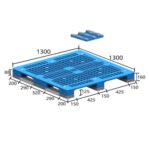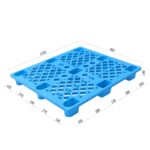
Injection molding is a manufacturing process where molten plastic is injected into a precision-made mold under high pressure, cooled, and released as a finished part — repeatable to tight tolerances, at any scale.
This guide walks you through exactly how the injection molding process works, which materials make the difference between a pallet that lasts years versus one that warps after a season, and what to look for when choosing a manufacturer. By the end, you’ll have a clearer picture of what separates a well-engineered pallet from one that just looks the part — and the right questions to ask before you place an order.
What Is Plastic Injection Molding?
Plastic injection molding is a manufacturing process where molten thermoplastic resin is injected into a closed mold under high pressure, then cooled and ejected as a finished part. It’s one of the most widely used production methods in the world — precise, repeatable, and capable of turning out millions of identical components with almost no variation between them.
The materials used are thermoplastics: plastics that can be melted, shaped, and re-melted without degrading. This distinguishes them from thermoset materials, which cure permanently and cannot be reprocessed. For industrial plastic pallets and material handling products, thermoplastics like PP and HDPE are the standard — they’re tough, food-safe, and recyclable.
What makes injection molding especially well-suited for pallets is scale. Once a mold is built, each pallet comes out identical — same dimensions, same wall thickness, same structural performance. Whether you order 1,000 units or 500,000, you get the same product every time.
How Does the Injection Molding Process Work?
The injection molding manufacturing process has six stages — and understanding each one helps you ask better questions when sourcing custom pallets.
- Mold Tooling.
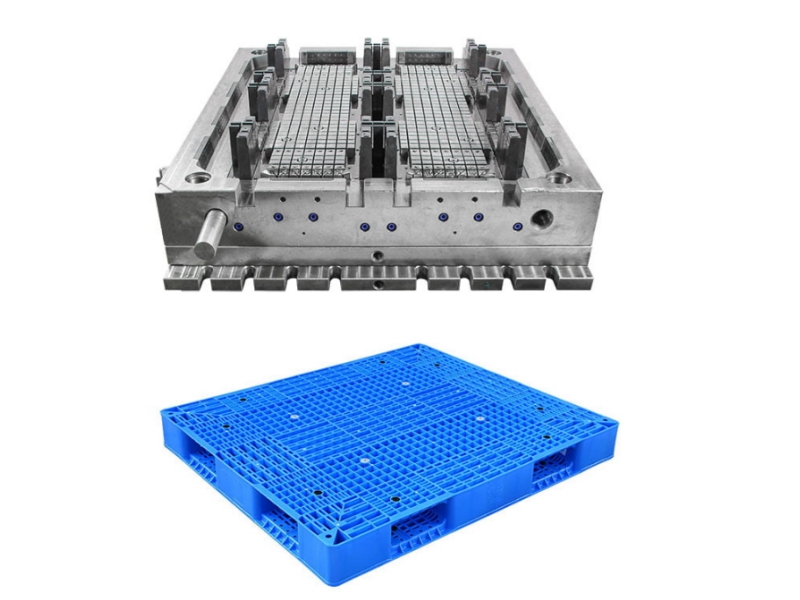
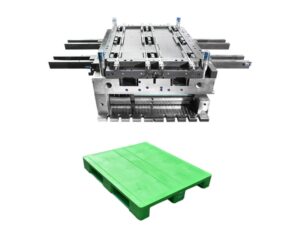
Everything starts with the mold — a precision-machined steel or aluminum tool, typically made in two halves. The line where those halves meet is called the parting line; it’s visible on the finished pallet and is a normal feature of any injection molded part. Good mold design accounts for draft angles (slight tapers that let the pallet release cleanly), uniform wall thickness (to prevent warping and sink marks), and a network of internal cooling channels that control cycle time. A well-engineered mold is the foundation of a consistent, high-quality pallet.
- Clamping.
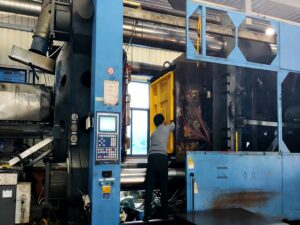
Before any material is introduced, a plastic injection molding machine clamps the two mold halves together under high pressure — often hundreds of tonnes of force — to form a sealed cavity. The clamping force has to be strong enough to resist the injection pressure that follows.
- Injection.
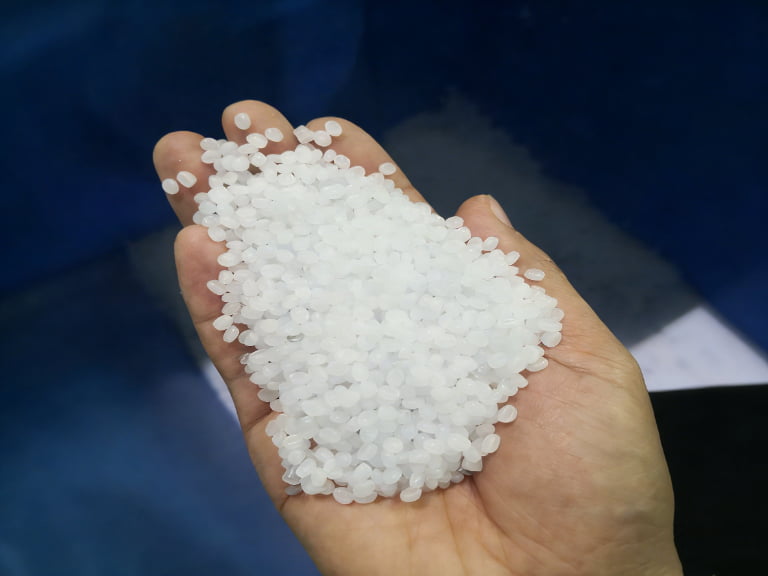
Plastic resin pellets are fed into the machine’s heated barrel, melted down, and then pushed through a gate — the controlled entry point into the mold cavity — at high pressure. The gate location and size directly affect how evenly the mold fills and where the material flow lines appear on the finished part. For larger pallets with complex geometry, multiple gates are often used.
- Dwelling & Cooling.
Once the cavity is filled, pressure is held briefly to compensate for shrinkage as the plastic cools — this phase prevents sink marks and voids. Then the mold cools, either through its built-in channels or, in more advanced tooling, via a hot runner system. A hot runner keeps the resin in the delivery channels molten between shots, eliminating the sprue and runner waste that cold runner systems generate, and shortening overall cycle time.
- Ejection.
The mold opens and ejector pins push the finished pallet out. Any excess plastic from the sprue or runner system — the channels that fed material into the cavity — is collected, reground (known as regrind), and fed back into the process. Well-run facilities keep regrind ratios controlled to preserve material performance. One issue to watch for at this stage is flash: thin slivers of plastic that form when a small amount of resin seeps into the parting line. Good mold maintenance keeps flash to a minimum.
- Post-Processing (if required).
Depending on the application, pallets may go through trimming, surface treatment, logo printing, or the addition of ESD (electrostatic discharge) coatings for electronics handling environments.
Cycle time — the time it takes to complete one full injection mold cycle — is one of the most important production variables. For a standard plastic pallet, cycle times typically range from 30 seconds to a few minutes, depending on size and wall thickness. Multiply that by a multi-cavity mold that produces two or four pallets per shot, and production throughput adds up quickly.

What Materials Are Used for Injection Molded Pallets?
Material selection isn’t just a spec-sheet decision — it determines how your pallet performs in the field, how long it lasts, and whether it meets the regulatory requirements of your industry.
For the vast majority of injection molded plastic pallets, the choice comes down to two materials: PP and HDPE. Here’s how they differ in practice.
PP (Polypropylene) — The Most Widely Used Choice
PP is the default for most plastic pallet applications — and it earns that position through a combination of versatility, safety, and processability.
Polypropylene is food-contact safe (FDA/EU compliant), handles temperatures up to around 130°C, and resists a wide range of chemicals. Those properties make it well-suited for food production lines, cafeteria service pallets, and medical environments where repeated autoclave sterilization is required. It’s also easy to color and produces a clean surface finish — practical for color-coded logistics systems or retail-facing applications.
One limitation worth knowing: PP becomes brittle in sustained sub-zero temperatures. If your pallets will spend significant time in freezer storage or outdoor cold-climate environments, HDPE is the stronger choice.
HDPE (High-Density Polyethylene) — Built for Tough Environments
When the environment is harsh — cold, chemical-heavy, or high-impact — HDPE is the material that holds up.
High-density polyethylene maintains its toughness across a wide temperature range, including well below freezing. Its resistance to acids, alkalis, and industrial oils makes it a standard choice in automotive plants, chemical facilities, and cold chain logistics. A high strength-to-density ratio means you can build a heavy-duty plastic pallet with relatively thin walls without compromising load capacity.
HDPE also carries the #2 recycling code — one of the most widely accepted resins in global recycling infrastructure — which matters increasingly for procurement teams working toward sustainability targets.
Other Injectable Materials
Beyond PP and HDPE, a handful of other thermoplastics are used where specific performance requirements go beyond what the standard materials can offer.
ABS delivers superior impact resistance and a high-quality surface finish, making it common in precision injection molding applications for automotive parts pallets and electronics packaging. PC (polycarbonate) handles extreme heat and is optically clear — useful for inspection trays or high-temperature sterilization contexts. For semiconductor and PCB handling, ESD-dissipative compounds are blended into PP or HDPE base resins to provide the static protection those environments demand.
Where Are Injection Molded Pallets Used?
The short answer: anywhere components, products, or materials need to move, be stored, or be organized with consistency. Here’s how that plays out across industries.
| Industry | Typical Applications | Why Injection Molded Pallets? |
| Food & Beverage | Food-grade pallets for production lines, cold storage, cafeteria service | FDA-compliant PP, easy to sanitize, stackable |
| Medical & Pharma | Sterilization pallets, lab specimen pallets, instrument handling | Autoclave-safe, cleanroom-compatible, tight tolerances |
| Automotive | Parts staging pallets, assembly line component handling | Heavy-duty HDPE, oil-resistant, handles rough use |
| Electronics | PCB transport pallets, ESD-safe pallets, chip handling | Precise cavity fit; ESD-dissipative grades available |
| Warehousing & Logistics | Picking pallets, sortation pallets, circulation pallets | Stackable/nestable design; built for years of daily use |
| Retail & Display | Cosmetic display pallets, checkout counter pallets | Custom color and finish; clean, polished appearance |
One thing worth noting: a well-designed custom injection molded pallet often earns its keep across multiple functions in the same facility. A food manufacturer might use the same pallet on the production line, in cold storage, and in outbound shipping — eliminating the cost and coordination overhead of managing multiple pallet types.
What Are the Benefits of Injection Molded Pallets?
There are other ways to make plastic pallets — blow molding, roto-molding — so what makes injection molding worth the tooling investment?
- Precision you can rely on.
Injection molding is fundamentally a precision manufacturing process. Every pallet that comes off the line is dimensionally identical — within tight tolerances. When your pallets interface with automated conveyors, robotic systems, or racking that has fixed slot dimensions, that consistency isn’t a nice-to-have. Even a 1mm deviation can cause jams or pallet failures at scale.
- Long service life.
A quality injection molded pallet in PP or HDPE can handle years of daily use — industrial washdowns, stacking loads, forklift handling — without significant wear. The economics of a long-lived reusable plastic pallet vs. repeated disposable alternatives are rarely close once you run the numbers.
- Hygienic by design.
The smooth, non-porous surface that comes out of a well-maintained injection mold doesn’t harbor bacteria, absorb odors, or retain moisture. For food-grade plastic pallets and medical environments, this is a compliance requirement — not a feature.
- Functional complexity in a single part.
Reinforcing ribs, stacking ledges, drain channels, forklift entry points, anti-slip surfaces — all of this can be built directly into the mold. You get structural and functional sophistication without assembly or secondary operations.
- Scalability without compromise.
A multi-cavity mold can produce two, four, or more pallets per injection cycle. Combined with the short cycle times of modern plastic injection molding machines, output scales efficiently. Unit cost drops significantly as volume increases — which is why injection molding makes the most sense for businesses thinking in thousands of units, not dozens.
A logistics company replaced corrugated cardboard slip sheets and wooden pallets on one of their sorting lines with custom injection molded PP pallets. The new pallets ran for over three years before showing any meaningful wear — and the reduction in breakage and replacement orders paid back the mold cost within 14 months.
Are Injection Molded Pallets a Sustainable Choice?
It’s a fair question — and the answer is more nuanced than a simple yes or no.
The most significant sustainability advantage of injection molded pallets is reusability. Unlike single-use wooden pallets or cardboard alternatives, a well-built plastic pallet circulates. It gets used, washed, stacked, and reused hundreds or thousands of times. Studies comparing reusable plastic packaging systems to single-use alternatives consistently show lifecycle CO₂ reductions of 25–80%, once you account for the full use cycle rather than just material weight at the point of manufacture.
Material recyclability adds to that picture. PP (#5) and HDPE (#2) are both established recyclable resins. HDPE in particular has one of the best-developed recycling supply chains globally. At CN Plast, we also offer pallets produced with post-consumer recycled (PCR) content — reducing reliance on virgin resin without affecting structural performance.
The injection molding process itself generates minimal waste. Sprue and runner material, along with any rejected parts, is collected on the factory floor, reground, and reintroduced into the raw material feed. This closed-loop regrind system means the process has a far lower material waste rate than subtractive methods like CNC machining.
The honest caveat: the environmental benefit depends on what happens at end of life. If pallets are properly returned to a recycling stream and materials are recovered, the lifecycle story is strong. If they end up in landfill — or are made from multi-layer composite materials that can’t be separated — the picture changes. The best approach combines durable design (maximizing time in service) with a clear end-of-life plan from the start.
A useful reference point: for most PP and HDPE pallet designs, the carbon footprint of production is offset once the pallet replaces roughly 150–200 single-use alternatives over its lifetime. In active circulation, that threshold is typically reached within the first year of use.
Injection molding isn’t the only process behind durable plastic pallets. Blow molding and rotomolding each produce pallets with their own structural advantages — and depending on your load requirements and production volume, one of them may be a better fit than you’d expect. If you’re curious about either process, these two guides are worth a read:
What Is Rotomolding? Process, Materials, and Industrial Applications
What Is Blow Molding? A Complete Guide to Blow Molded Plastic Pallets
Better Pallets Start with Better Manufacturing — Let’s Build Yours
You now understand the injection molding process well enough to evaluate suppliers on your own terms — and that’s exactly the point.
The best pallet isn’t the cheapest one or the one with the most impressive spec sheet. It’s the one engineered for your operation: your load requirements, your environment, your handling systems. Getting there requires an injection molding company that will tell you when your design needs rethinking — not just quote whatever you send them.
CN Plast is a specialist plastic pallets manufacturer offering end-to-end injection molding services — from DFM review and mold tooling through to full-scale production. If any of these sound familiar, we can help:
- Your pallets don’t fit your line or racking. Our custom plastic injection molding service designs to your exact dimensions and load specs.
- You’ve had quality issues with your current supplier. We run dimensional verification on every batch and provide full traceability documentation.
- You’re not sure where to start. Share your use case — material, environment, volume — and we’ll walk you through DFM and give you realistic tooling cost and lead time upfront.
Browse our plastic pallets and plastic pallet moulds — or get in touch directly. Choosing the right injection molding services partner shouldn’t be a leap of faith. Tell us what you need, and we’ll tell you exactly what’s possible.