What Is an IBC? Types, Sizes & Spill Containment Guide
You’ve probably seen them on factory floors, in chemical warehouses, in the back of freight trucks. But how much do you actually know about how IBCs work? What makes one fail? And what happens when 1,000 liters of industrial liquid hits an unprotected floor?As a leading provider at Qingdao CNplast Co., Ltd., we’ve helped thousands of facilities secure their IBC containers against costly leaks.
If you’re sourcing IBCs — or responsible for storing them safely — the answers matter more than you might think. This guide covers everything from IBC types and standard sizes to spill containment compliance, so you can make the right call before something goes wrong.
What’s an IBC?
IBC stands for Intermediate Bulk Container. In plain terms, it’s a large, reusable industrial container built to store and transport high volumes of liquid, paste, or granular material — typically between 275 and 330 gallons (roughly 1,000–1,250 liters) in a single unit. These capacities align with the most common international standards for rigid IBCs, where 1,000 L and 1,250 L (275 and 330 US gallons) are the predominant sizes.
If you’ve ever spotted a square plastic-and-metal tank sitting on a pallet in a warehouse or chemical plant, that’s an IBC.
The word “intermediate” is the key to understanding what makes it different. It sits between two extremes: on one end, you have small containers like bottles and 55-gallon drums; on the other, you have fixed storage tanks that stay in one place. An IBC is the middle ground — big enough to move meaningful quantities of product, but still portable enough to load onto a truck, fork lift into a racking system, or ship overseas.
Think of it this way: where you’d need 18 standard 55-gallon drums to move 1,000 liters of chemical, one IBC does the same job — with one handling step, one valve, and far less labor. That’s the core appeal, and it’s why IBCs have become a default packaging format across chemical, food, pharma, and agriculture supply chains worldwide.A standard 1,000-liter IBC holds the equivalent of approximately five 55-gallon drums (each ~208 liters) while using a similar pallet footprint, delivering about 25% more product in the same storage space.
What Is an IBC Used For?
IBCs are built for bulk handling — not small quantities. A single IBC typically holds between 275 and 330 gallons (roughly 1,000–1,250 liters), which immediately makes it far more efficient than managing four or five separate 55-gallon drums for the same volume.
You’ll find them in use across a wide range of industries:
- Chemical & petrochemical — acids, solvents, lubricants, and industrial cleaning fluids
- Food & beverage — edible oils, syrups, liquid flavorings, and bulk dairy ingredients
- Pharmaceutical — bulk active ingredients and process fluids
- Agriculture — fertilizers, pesticides, and liquid animal feed
- Construction & coatings — resins, paints, adhesives, and water treatment chemicals
The core appeal is straightforward: one IBC does the work of multiple drums, with fewer handling steps, less packaging waste, and a smaller storage footprint. For procurement teams managing high-volume liquid flows, that efficiency adds up quickly.
What Are the Main Types of IBCs?
Not all IBCs are built the same — your choice depends on what you’re storing and how you need to move it. Here are the three main categories.
| IBC Type | Main Material | Typical Capacity | Best For | Reusability | Spill Containment Needed |
| Rigid IBC | HDPE + Steel Cage | 1000L | Chemicals & Liquids | High | Yes |
| Flexible IBC (FIBC) | Woven PP | 500–2000kg | Powders & Granules | Medium | Usually No |
| Stainless Steel IBC | Stainless Steel | 500–1500L | Food & Pharma | Very High | Yes |
Rigid IBC
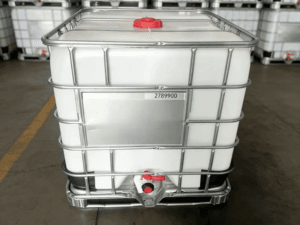
The Rigid IBC is the industry standard. When pairing these with an IBC spill containment pallet, it’s crucial to ensure the pallet base is compatible with the IBC’s integrated pallet dimensions.This is the type most people picture when they hear ‘IBC.’ A rigid IBC consists of an HDPE or LLDPE inner bottle enclosed in a galvanized steel cage, all mounted on an integrated pallet base. The standard 1000L IBC container typically measures 1200x1000x1160mm. For these Rigid IBC units, choosing a heavy-duty IBC spill containment pallet with a 4-way forklift entry is essential for operational efficiency and IBC spill containment compliance.
Flexible IBC (FIBC / Big Bag)
Often referred to as a bulk bag or super sack, the flexible IBC is crafted from woven polypropylene material.You can simply think of it as a extra-large industrial tote. It’s light in weight, easy to fold flat when not in use, and mainly made to hold dry bulk goods — things like fine powders, granules, grain crops and plastic pellets.
It’s budget-friendly whether you use it once only or reuse it a few times, and you’ll find it widely applied across farming, chemical production and the construction industry.

What Is an IBC Spill Containment Pallet?
Here’s where the safety picture comes in. An IBC holds up to 1,000+ liters of liquid. If a bottom valve fails or a fitting cracks, that’s a large-scale spill — with real consequences for your facility, your team, and the environment.
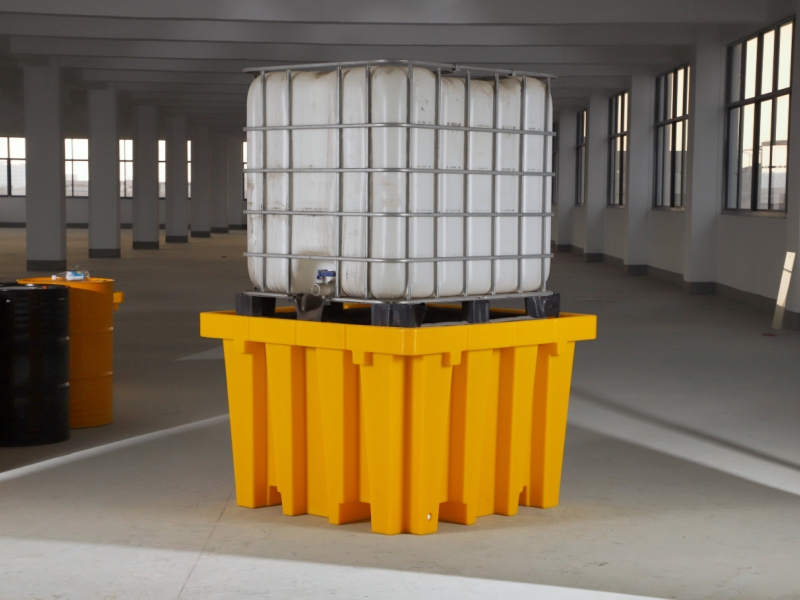
An IBC spill containment pallet (sometimes called a spill pallet, IBC containment pallet, or pallet spill containment unit) is a secondary containment platform placed directly beneath an IBC. Its job is simple: catch any leaks or overflows before they reach the floor, drain into the drainage system, or contaminate groundwater.
The structure consists of two key parts. First, a grated load deck on top — sturdy enough to support the full weight of a filled IBC — which allows any leaked liquid to drain downward. Second, an enclosed sump beneath the deck that collects and holds the fluid until it can be safely removed.
The sump volume is a critical spec, not a secondary one. Most regulatory frameworks require the sump to hold at least 110% of the IBC’s maximum storage volume. For a standard 1,000L IBC, that means your spill containment pallet needs a minimum sump capacity of 1,100L.Under the U.S. EPA’s Spill Prevention, Control, and Countermeasure (SPCC) rule, secondary containment systems must be sized to hold the full capacity of the largest container plus sufficient freeboard to account for precipitation.At CNplast, we don’t just follow the 110% rule; we engineer for real-world failure. In our 26 years of manufacturing, our standard IBC leak-proof pallets are all made using rotational molding and equipped with reinforced structural columns, which can effectively prevent the pool wall from bending and deforming under sudden hydraulic pressure.
IBC spill containment pallets are made from LLDPE (Linear Low-Density Polyethylene) and formed using rotational molding(rotomolding) — a process that produces seamless, one-piece construction with no joints or weld lines where leaks could form. The result is a pallet that’s both chemically resistant and tough enough to handle the full weight of a loaded IBC day after day.
According to EPA 40 CFR 264.175, secondary containment systems must be liquid-tight and have sufficient capacity to contain 10% of the volume of containers or the volume of the largest container, whichever is greater. At CNplast, our 1,100L sumps are specifically engineered to exceed these SPCC requirements for standard 1,000L IBCs.
| Regulation | Region | Requirement |
| EPA SPCC | United States | Secondary containment required |
| OSHA | United States | Hazardous liquid storage safety |
| ADR | European Union | Dangerous goods transport compliance |
| REACH | European Union | Chemical material compliance |
Available IBC Spill Containment Pallet Styles
Different storage layouts match different pallet types. Single IBC spill containment pallets are made for individual IBC storage. With a standard 1,600L sump capacity, it fully meets compliance demands for 1,000L IBCs and works well for separated storage and chemical segregation scenarios.
Double IBC spill containment pallets support side-by-side placement of two IBCs. They help factories cut down redundant containment units and are ideal for centralized storage of compatible materials, with a sump capacity of 1,100L or higher. For workshops using both drums and IBCs, 4-drum spill containment pallets offer flexible matching solutions to cover mixed-specification storage needs.
| IBC Type | Best For | Recommended Containment |
| Rigid IBC | Chemicals / Liquids | Single or Double IBC Spill Pallet |
| Flexible IBC (FIBC) | Powders / Granules | Standard Heavy Duty Pallet |
Core Criteria for Pallet Selection
Choosing a suitable spill pallet relies on several practical factors. Sump capacity is the top priority, always meeting or exceeding the 110% volume standard for safety. The pallet’s UDL load rating must fully support the 1,300–1,500kg weight of a filled 1,000L IBC, with parameters verified from official datasheets.
Forklift entry options affect on-site handling flexibility. 2-way entry fits regular warehouse layouts, while 4-way entry works better for narrow aisles. Material selection depends on stored substances: LLDPE and HDPE suit most common chemical liquids, while conductive or steel pallets are required for flammable and electrostatic-sensitive materials. For outdoor placement, UV-stabilized materials and professional drainage management are necessary to avoid rainwater polluting captured spill fluids.
Compliance Standards and Daily Maintenance
Global regions have clear regulations for IBC spill containment. The US follows EPA SPCC and OSHA standards for hazardous liquid storage. The EU enforces ADR dangerous goods rules and local water protection laws for water-hazardous materials. Cross-border operations require pallets with authoritative certifications like ISO 9001, CE and REACH.
Simple daily maintenance can extend pallet service life and sustain compliance. Monthly inspections for cracks and damage are recommended. Operators should keep drainage plugs sealed and pallet surfaces clean. A regular rinse is necessary for sumps used to store corrosive chemicals.
CNplast Manufacturing Strengths
With 26 years of professional manufacturing experience, CNplast supplies premium LLDPE rotomolded spill containment pallets. All products hold global mainstream certifications, complying with US, EU and Australian market standards. Reinforced structural design resists sudden hydraulic pressure from liquid surges during IBC leakage, ensuring stable performance. Not sure which model fits your sump requirement or site layout? Tell us your IBC volume, the liquid you’re storing, and your forklift access configuration. We’ll specify the right custom IBC spill containment pallet for you.
FAQ
Q:Why choose CNplast LLDPE spill pallets over steel ones?
A:Qingdao CNplast Co., Ltd. uses a seamless rotational molding process to create 100% corrosion-resistant LLDPE pallets. Unlike steel, our IBC spill containment pallet won’t rust when exposed to acids or caustics, ensuring a longer service life for your IBC container storage.
Q:Can CNplast customize pallets for my specific site layout?
A:Yes. Whether you need a Single IBC spill containment unit for tight spaces or a Double IBC spill containment pallet for bulk storage, CNplast offers various UDL load ratings and 4-way forklift entry options to optimize your facility’s efficiency.
Q:Do CNplast pallets meet EPA and international standards?
A:Absolutely. Every IBC spill containment pallet from Qingdao CNplast Co., Ltd. is engineered to exceed EPA SPCC and ADR requirements. Our 1,100L+ sumps ensure 110% containment for any standard 1000L IBC, keeping your site compliant and safe.