In the modern logistics landscape, selecting the right manufacturing partner is a strategic imperative for technical due diligence and global supply chain optimization. The durability of a pallet—its ability to withstand rigorous material handling cycles and maintain structural integrity in extreme cold chain conditions—is directly linked to its manufacturing origin. Qingdao CNplast Co., Ltd. provides tailored load-bearing solutions for diverse industrial needs. This guide outlines the core mechanics of blow molding and its unique advantages for high-demand industrial pallet applications. Core Technical Principles of Industrial Blow Molding Industrial blow molding is a high-precision thermoplastic manufacturing process. It heats plastic resin until soft, then uses pressurized air to expand the material inside a precision mold, creating uniform hollow plastic products.
Technical Fundamentals of the Blow Molding Process
Industrial blow molding is a high-precision thermoplastic transformation process that utilizes pressurized air to inflate heated resin into a hollow form within a secure mold. Unlike simpler forming methods, this process ensures superior energy absorption and uniform wall thickness. It is widely utilized for critical industrial products such as automotive fuel tanks and agricultural reservoirs. Among these, durable blow molded plastic pallets from China have emerged as one of the most demanding applications and optimal logistics solutions available today. The resulting one-piece hollow structure provides unparalleled impact resistance and an extended service life.
Thermal Management and Material Preparation
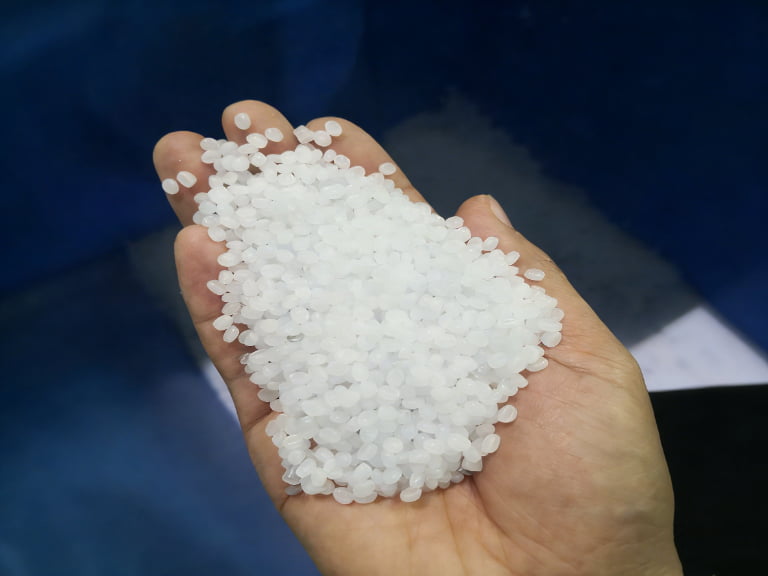
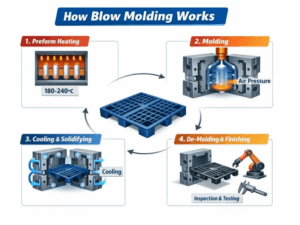
The manufacturing sequence begins with heating the plastic—typically High-Density Polyethylene (HDPE)—until it reaches its thermoelastic range, generally between 180°C and 240°C. Thermal homogeneity is a critical Quality Control (QC) benchmark; any temperature variance can result in uneven wall thickness, leading to structural compromises under load. At Qingdao CNplast Co., Ltd., we’ve observed through 10+ years of testing that a temperature deviation of even 5°C in HDPE parisons can reduce pallet impact resistance by 15%. Our facility integrates ISO-certified testing protocols, including deflection analysis and static load verification, ensuring each unit exceeds industry benchmarks.
Precision Molding and Structural Formation
Once the material is sufficiently malleable, pressurized air is injected through a nozzle, forcing the plastic against the inner walls of the mold. This stage defines the pallet’s functional architecture, including forklift entry channels, anti-slip textures, and reinforcement columns. The quality of the blow mold tooling dictates the consistency of every unit. Because the process creates a continuous, single-piece structure without secondary assembly or machining, the pallet lacks the weak seams common in other manufacturing methods.
Controlled Solidification and Quality Verification
After the form is established, the plastic must be cooled uniformly to retain its shape. High-tier blow molding equipment utilizes advanced fluid cooling channels to balance speed with consistency, preventing warping or the development of internal stress points. Following de-molding, the pallet undergoes post-processing, including flash trimming and dimensional inspection. At CNplast, every pallet is static- and dynamic-load tested before it ships, ensuring that only robust, conforming products reach the end-user.
Comparative Analysis of Blow Molding Methodologies
While there are three primary types of blow molding—Extrusion Blow Molding (EBM), Injection Blow Molding (IBM), and Injection Stretch Blow Molding (ISBM)—their industrial utility varies significantly. As a leading China blow molded pallet manufacturer, CNplast focuses exclusively on Extrusion Blow Molding (EBM) to ensure the highest heavy-duty performance for our global clients.
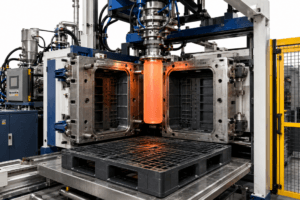
EBM is the industry standard for pallet production due to its suitability for large-format parts. In this process, molten plastic is extruded into a hollow tube called a parison before the mold closes and inflation begins. While IBM and ISBM offer tighter dimensional tolerances for small-scale items like pharmaceutical bottles or PET containers, they are restricted by size limitations and higher tooling costs. EBM remains the most efficient and cost-effective method for producing high-strength, large-scale logistics assets.For enterprises seeking a reliable blow molded plastic pallet supplier from China, CNplast provides wholesale blow molded pallets that meet global shipping standards.
| Dimension | Blow Molding | Injection Molding | Rotational Molding |
| Core structure | Hollow, one-piece | Solid/ribbed | Hollow, one-piece |
| Surface finish | Functional texture | Smooth, glossy | Uneven |
| Wall thickness uniformity | Medium | High | Low |
| Steel reinforcement | Not possible | Possible | Possible |
| Fork entry | 2-way or 4-way | 2-way or 4-way | 2-way or 4-way |
| Mold cost | Medium | High | Low |
| Typical pallet type | Nestable/double-faced | All types | Spill containment/chemical |
| Best suited for | High-impact, cold chain | high-density racking & automated storage | Chemical / specialized |
What Types of Blow Molded Pallets Are There?
Blow molded pallets come in two main formats. They serve different operational needs, and understanding the difference will save you from procurement misalignment.
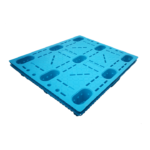
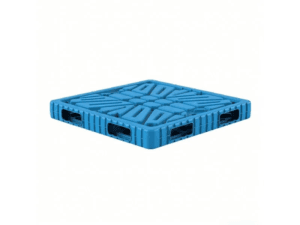
Double-face blow molded pallets for Heavy-Duty Racking
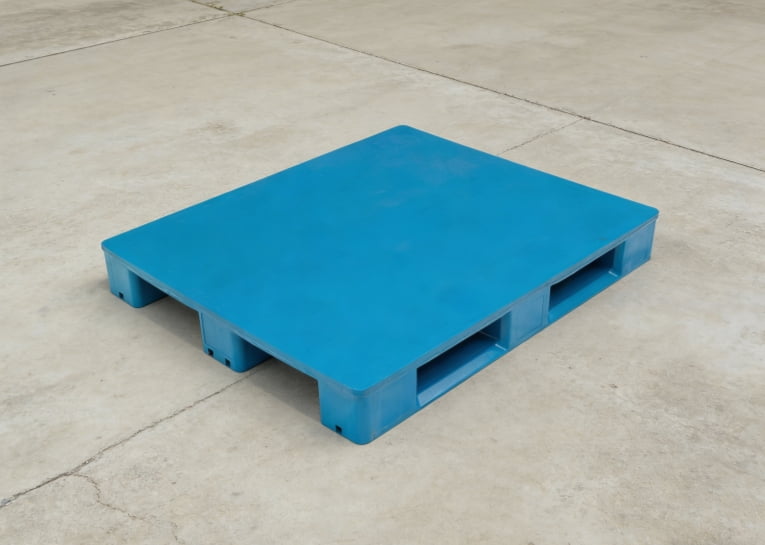
The classic format: two flat deck surfaces connected by hollow structural columns. Both surfaces are usable, so you can flip the pallet when one side shows wear, which meaningfully extends service life.
Double-face blow molded pallets are the go-to for heavy-load warehouse applications, racking systems, and production environments with repeated pallet use. Standard sizes include 1200×1000mm (European standard) and 1200×1200mm (common in Asia-Pacific markets). Custom dimensions are available for specialized applications.
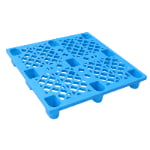
9-Leg Nestable Pallets
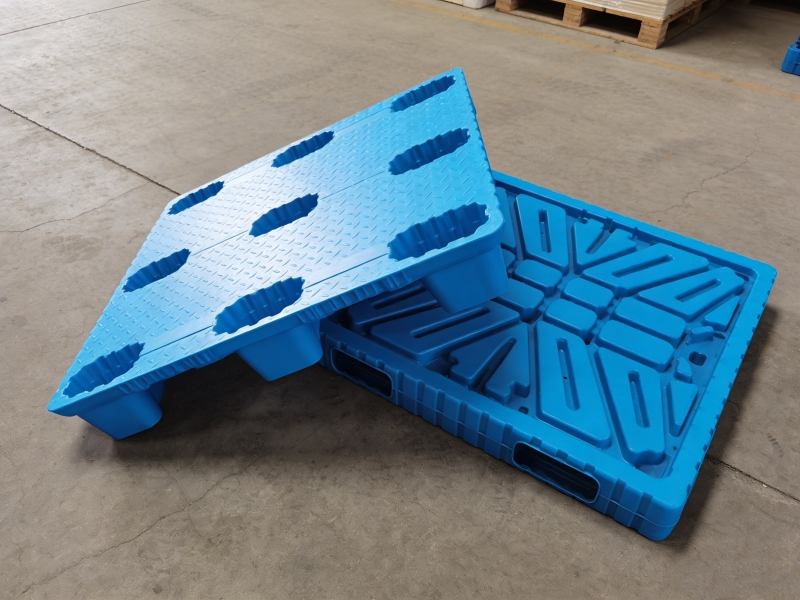
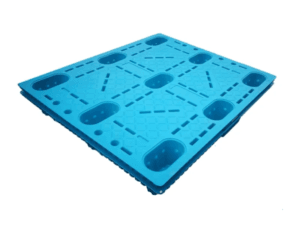
9-leg nestable blow molded pallets are the fastest-growing segment in blow molded plastic pallets — and it’s easy to see why. When empty, they stack inside one another, reducing return freight costs and storage space by up to 75% compared to double-faced designs.CNplast stackable and nestable plastic pallets are optimized for international freight.
These pallets are lighter (typically 8–14kg vs. 18–25kg for double-faced) and well-suited for one-way or limited-use logistics chains. They’re widely used in FMCG distribution, retail supply chains, and export applications.
Material Science and Sustainability in Pallet Engineering
Extrusion Blow Molding (EBM) manufactured HDPE pallets are ideal for chemical and cold-chain industries. HDPE is a standard industrial material with reliable impact resistance and cost efficiency, delivering stable performance across temperatures from -40°C to 70°C, which perfectly meets cold chain logistics demands. Fully recyclable, it also complies with global sustainability rules.
In line with circular economy concepts, CNplast provides HDPE sustainability programs. Our eco-friendly material solutions help business partners effectively reach their ESG targets.For high-standard specialized scenarios, PP material is the optimal alternative. It withstands temperatures up to 100°C and supports autoclave sterilization, making it suitable for hygienic-sensitive environments like pharmaceutical cleanrooms and food processing facilities.We offer complete spec sheets and load test data for all pallets.
For specialized environments, Polypropylene (PP) is utilized. PP can withstand temperatures up to 100°C and is compatible with autoclave sterilization, making it ideal for pharmaceutical cleanrooms and food processing facilities that require steam cleaning. Regardless of the material chosen, reputable suppliers provide comprehensive spec sheets and load test data to mitigate the risks associated with material inconsistency.
Performance Under Pressure: Why Blow Molding Wins in Cold Chain Logistics
When temperatures drop to -30°C or below, standard industrial plastic pallets often become brittle, leading to expensive cracks during forklift handling. This is where Extrusion Blow Molding (EBM) reveals its true strength.
CNplast Blow Molded Plastic Pallets Performance & Advantages
High-pressure injection molding often leaves residual internal stress in standard plastic pallets. By contrast, CNplast’s blow molded pallets use a low-pressure process to achieve a fully stress-free molecular structure.
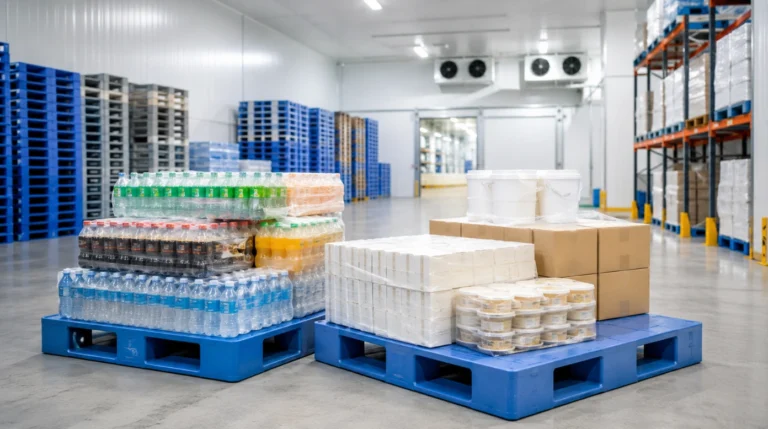
Our Qingdao-made HDPE blow molded pallets preserve elastic-plastic properties in deep-freeze settings. The built-in bounce-back effect prevents cracking and fracture under high-impact loads, making them ideal for global frozen food distribution and pharmaceutical cold chain logistics.
Key Applications & Operational Advantages
Blow molded pallets suit high-standard industrial scenarios that allow zero product failure. Their seamless, non-porous surface resists bacterial growth and simplifies sanitization, delivering critical hygiene benefits for food and beverage production.
Unlike wooden pallets and low-grade plastic alternatives that splinter and crack in sub-zero conditions, our HDPE pallets maintain stable structural integrity in freezing environments, ensuring reliable performance for pharmaceutical and cold chain operations.
International Compliance and Export Efficiency
Blow molded plastic pallets greatly simplify cross-border trade compliance, which is one of their biggest advantages. Traditional wooden pallets must comply with ISPM 15 standards, mandating expensive heat treatment or fumigation to stop pest spread. Plastic pallets are exempt from these rules. This lets exporters skip compliance certificates, avoid customs delays from unqualified wooden pallets, and cut regular operational and administrative costs.
Durability for High-Volume Warehouse Operations
Pallet durability directly affects the total cost of ownership in industrial and high-density warehousing environments. Blow molded plastic pallets outperform other materials in absorbing and dispersing impact force, so fewer units get damaged by forklifts and taken out of service. Their stable, consistent dimensions also work perfectly with automated storage and retrieval systems (ASRS), effectively preventing conveyor jams and sensor malfunctions caused by inconsistent pallet sizes.
Strategic Procurement and Customization
Understanding the distinction between pallet formats is essential to avoid procurement misalignment. Double-face pallets provide two usable decks and are ideal for heavy-load racking systems. CNplast stackable and nestable plastic pallets are optimized for international freight, balancing weight efficiency with load-bearing capacity.
Selecting a pallet requires a detailed analysis of dynamic, static, and racking loads. Dynamic load refers to the weight during movement, while static load applies to stationary storage.
CN Plast manufactures blow molded and injection molded plastic pallets across a full range of specifications and custom dimensions. Selecting the optimal configuration can be a complex technical decision. To ensure your pallet choice aligns perfectly with your specific racking requirements and freight goals, contact our engineering team for a personalized load-capacity assessment.
FAQ
Q: How do blow molded pallets reduce TCO (Total Cost of Ownership)?
A: By offering superior impact resistance and a seamless one-piece structure, they minimize replacement frequency and prevent product damage from splinters or structural failure.
Q: Can these pallets be used in automated ASRS systems?
A: Yes, our blow molded series is designed with precise dimensional stability, making them compatible with high-speed automated storage and retrieval systems.
Q: How do blow-molded pallets compare to injection-molded ones in terms of impact resistance in busy high-traffic warehouses?
A: The biggest difference comes down to energy absorption and crash resistance. Injection-molded pallets are extremely rigid and stiff. When forklift tines hit them during daily operations, they often crack or chip quite easily. In contrast, blow-molded pallets feature a double-wall hollow structure that delivers built-in cushioning and flexible rebound.
Q: Are blow-molded pallets more prone to slipping during transit compared to traditional wooden pallets?
A: Modern blow-molded pallets come with textured surface finishes and dedicated anti-slip grommets. Unlike generic smooth plastic pallets, these are engineered with a precise friction coefficient. They keep unitized loads stable and secured even during sudden acceleration or hard braking in heavy-duty road transportation, effectively preventing cargo shifting and slipping.
Q: Can blow-molded pallets handle heavy racking loads without internal steel reinforcements?
A: Yes, they absolutely can. Most injection pallets require embedded steel bars for heavy racking use, otherwise they will bend and sag under weight. Blow-molded pallets perform differently thanks to their integrated structural pillar design that delivers exceptional inherent rigidity. The one-piece high-density beam structure evenly distributes racking pressure and avoids localized overloading.
Q: How do these pallets perform on hygiene and wash-down requirements for pharmaceutical environments?
A: Blow-molded pallets are widely favored in the pharmaceutical industry mainly because of their fully seamless construction. There are no gaps, holes, screw joints or crevices where dust, moisture or bacteria can build up. The non-porous HDPE material holds up well against chemical sanitizers and high-pressure steam cleaning. It fully complies with FDA and GMP cleanroom requirements for hygienic operations.