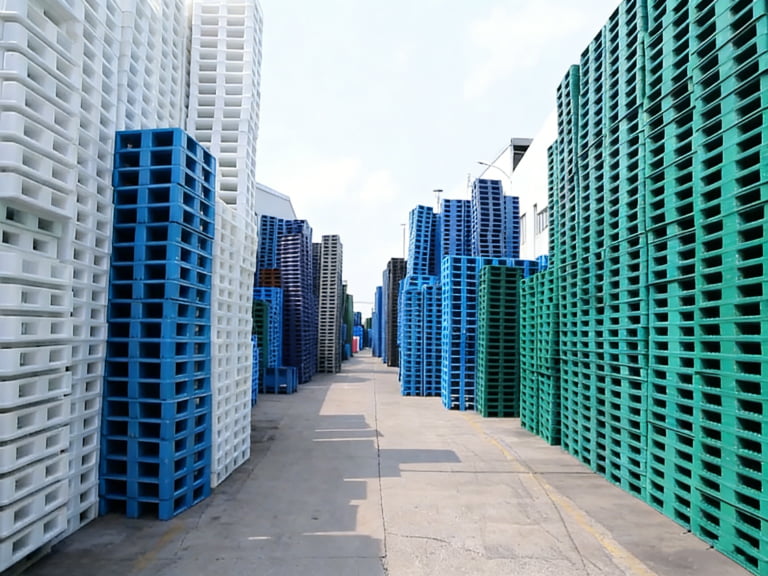
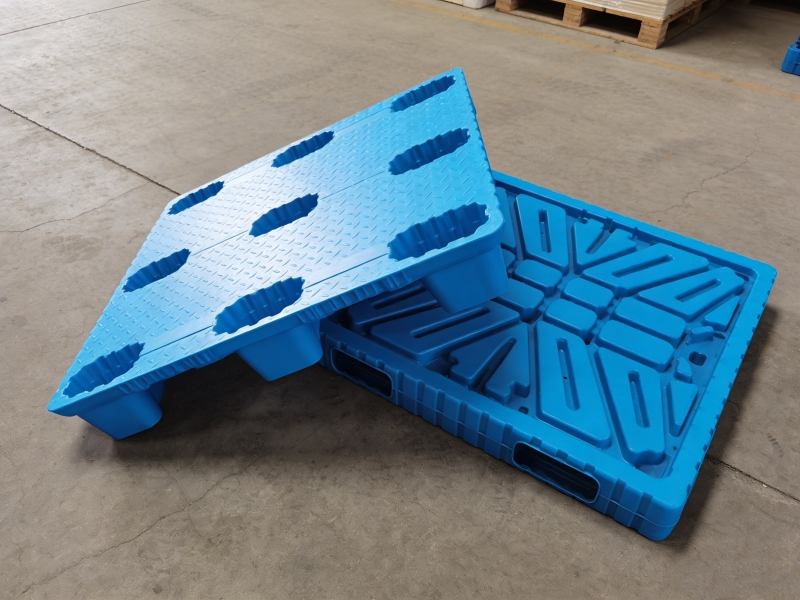
What is blow molding — and why does it matter for plastic pallets? Whether you’re researching the process from scratch or evaluating suppliers, the two questions are more connected than they look. What makes a pallet strong enough to survive years of forklift traffic? Why do blow molded pallets hold up in cold chain conditions where other materials fail? And what does the manufacturing process have to do with how long your pallets last?
This guide walks you through how blow molding works, the three main process types, materials that matter for pallet performance, and where blow molded pallets deliver the most value.
What Is Blow Molding?
Think of blow molding like blowing up a balloon — except the balloon is molten plastic, and the mold gives it a precise, permanent shape. More formally, it’s a manufacturing process that uses pressurized air to inflate heated thermoplastic into a hollow form inside a closed mold.
The process produces a wide range of blow molding products across industries: automotive fuel tanks, agricultural fluid reservoirs, consumer packaging, and industrial containers — making it one of the most versatile industrial blow molding processes in modern manufacturing. Among these, plastic pallets are one of the most demanding applications — and one of the best fits. The one-piece hollow structure blow molding produces pallets with their strength, impact resistance, and long service life.
How Does Blow Molding Work?
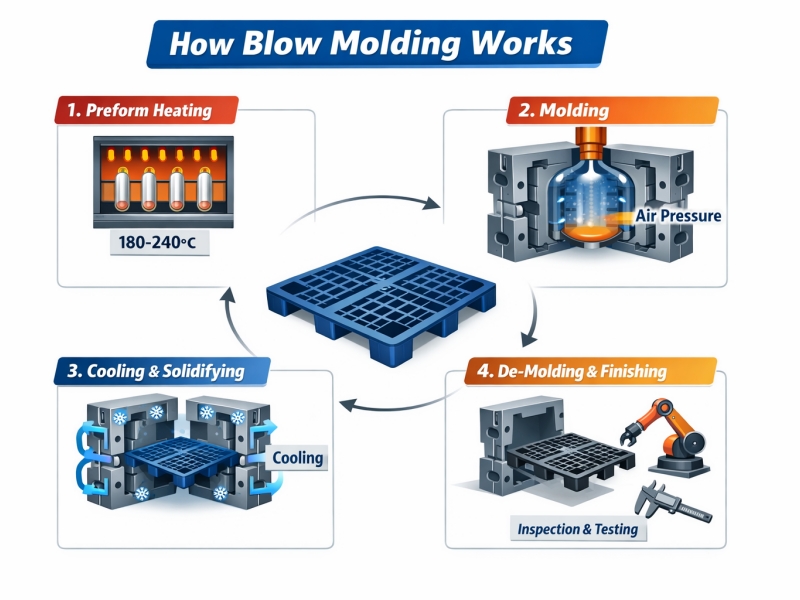
The blow molding manufacturing process breaks down into four stages. Each one has a direct effect on pallet quality — skip one or do it poorly, and you’ll see it in the finished product.
Step 1: Perform Heating
Before the plastic can be shaped, it needs to reach its thermoelastic range — soft enough to expand, but not so hot that it loses its structural integrity. For HDPE (the most common material for blow molded pallets), that’s roughly 180–240°C.
For pallets, even heating is non-negotiable. Uneven temperature creates uneven wall thickness, which means certain spots will be weaker under load. A pallet that looks fine might flex or crack at the very points where your goods — or forklift — put the most stress.
Step 2: Molding
Once the plastic is malleable, pressurized air is injected through a nozzle. The plastic expands outward and presses against the inner walls of the mold, taking on its exact shape.
This is where a pallet gets its functional design. Forklift entry channels, anti-slip surface textures, reinforcement columns, drainage holes — all of it is defined by the blow mold design. This is also where blow mold tooling quality directly determines the consistency of every part that comes off the line. No secondary machining. No assembly. Just one continuous piece.
Step 3: Cooling and Solidification
After forming, the plastic must cool below its thermoelastic range so it holds its shape when the mold opens. Most plastic blow molding machines accelerate this with fluid cooling channels or chilled air, and the quality of that blow molding equipment has a direct impact on cycle time and part consistency.
Cooling uniformity matters just as much as heating uniformity. Cool too fast, and the pallet warps. Cool unevenly, and internal stress points develop — invisible in the short term, but they shorten service life. The best machines balance both speed and consistency.
Step 4: De-Molding and Post-Processing
Once cooled, the pallet is ejected and moves down the line: trimming flash (the thin plastic that seeps into mold seams), dimensional checks, surface inspection, and load testing.
Modern production lines automate most of this. Visual QC, however, remains a human task — and it’s where the difference between a robust pallet and a borderline one gets caught. At CN Plast, every pallet is static- and dynamic-load tested before it ships.
What Are the Three Types of Blow Molding?
The three main types — EBM, IBM, and ISBM — differ primarily in how the plastic preform is created. For pallet manufacturing, one of them is the clear front-runner.
Extrusion Blow Molding (EBM)
EBM is the most widely used type of blow molding, and it’s the standard method for producing plastic pallets. Here’s the process: molten plastic is pushed through an extruder to form a hollow tube called a parison. The mold closes around the parison, and pressurized air inflates it to fill the cavity.
Parison blow moulding is well-suited to large-format parts because there’s no size constraint from a pre-formed blank. It’s also faster and less expensive than the alternatives — which matters when you’re producing thousands of pallets. The main trade-off is less precise control over wall thickness — an inherent characteristic of parison blow moulding, but for most pallet applications, this is entirely acceptable.
Injection Blow Molding (IBM)
IBM is a two-stage process: first, molten plastic is injection-molded into a precise preform. Then that preform is transferred to a blow mold, reheated, and inflated. The injection molding step gives IBM much tighter dimensional control than EBM.
This makes IBM ideal for complex shapes with strict tolerances — pharmaceutical bottles, cosmetic containers, and similar precision parts. For pallets, the size limitations and higher tooling costs make it an uncommon choice.
Injection Stretch Blow Molding (ISBM)
ISBM adds one more step to IBM: a stretch rod extends the preform axially before air is injected. This biaxial stretching improves clarity and barrier properties — it’s how PET water bottles achieve that characteristic stiffness and transparency.
ISBM produces the most precise parts of the three methods. But it’s also the slowest and most expensive. You’ll find ISBM in bottles and specialty containers, not pallets.
Watch how blow molding works:
What Materials Are Used to Make Blow Molded Pallets?
Material choice determines almost everything about a pallet’s performance: weight, load capacity, temperature range, chemical resistance, and service life. For blow molded pallets specifically, the options narrow quickly.
HDPE — The Industry Standard
High-density polyethylene (HDPE) is the dominant material in blow molded plastic pallet production — and for good reason. It balances performance and cost better than any alternative:
- Impact resistance: absorbs repeated forklift strikes without cracking
- Temperature range: stable from -40°C to 70°C, reliable in cold chain logistics
- Chemical resistance: unaffected by most cleaning agents and mild chemicals
- Food safety: available in food-grade grades compliant with FDA and EU standards
- Recyclability: fully recyclable at the end of service life
Blow molded polyethylene pallets dominate logistics operations worldwide precisely because HDPE performs consistently under real-world conditions.
PP — For High-Temperature and Sterile Environments
Polypropylene (PP) handles temperatures up to around 100°C and can withstand autoclave sterilization. You’ll find PP pallets in pharmaceutical cleanrooms and food processing facilities that require steam cleaning or high-temperature washing. Like HDPE, PP is fully recyclable at the end of its service life.
Recycled HDPE (rHDPE)
More manufacturers are offering pallets with recycled HDPE content, responding to procurement teams with sustainability targets. Well-formulated rHDPE blends (typically 30–50% recycled content) perform comparably to virgin material in most applications.
Higher recycled content can introduce consistency variation, so always request spec sheets and load test data. A reputable supplier will provide both without hesitation.
Beyond pallets, blow molding works with a broader range of materials — PET for beverage bottles, PVC for pipes and fittings, and nylon for automotive tubing and fluid reservoirs.
Blow Molding vs. Injection Molding vs. Rotational Molding: How Do They Compare?
When evaluating plastic pallets, you’ll encounter products made by all three processes. Each has genuine strengths — the right choice depends on your use case, not on which process sounds most impressive.
| Dimension | Blow Molding | Injection Molding | Rotational Molding |
| Core structure | Hollow, one-piece | Solid/ribbed | Hollow, one-piece |
| Surface finish | Functional texture | Smooth, glossy | Uneven |
| Wall thickness uniformity | Medium | High | Low |
| Steel reinforcement | Not possible | Possible | Possible |
| Fork entry | 2-way or 4-way | 2-way or 4-way | 2-way or 4-way |
| Mold cost | Medium | High | Low |
| Typical pallet type | Nestable/double-faced | All types | Spill containment/chemical |
| Best suited for | High-impact, cold chain | Standard warehouse | Chemical / specialized |
If you want to learn more about injection molding, check out our in-depth guide: What Is Injection Molding?
Curious about how rotomolding works? Our guide: What Is Rotomolding? covers the full process, materials, and key applications.
What Types of Blow Molded Pallets Are There?
Blow molded pallets come in two main formats. They serve different operational needs, and understanding the difference will save you from buying the wrong one.
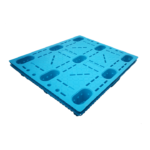
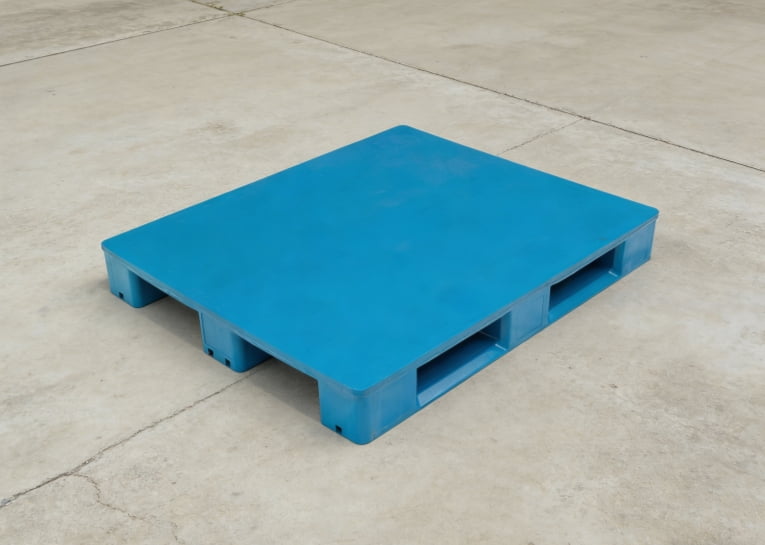
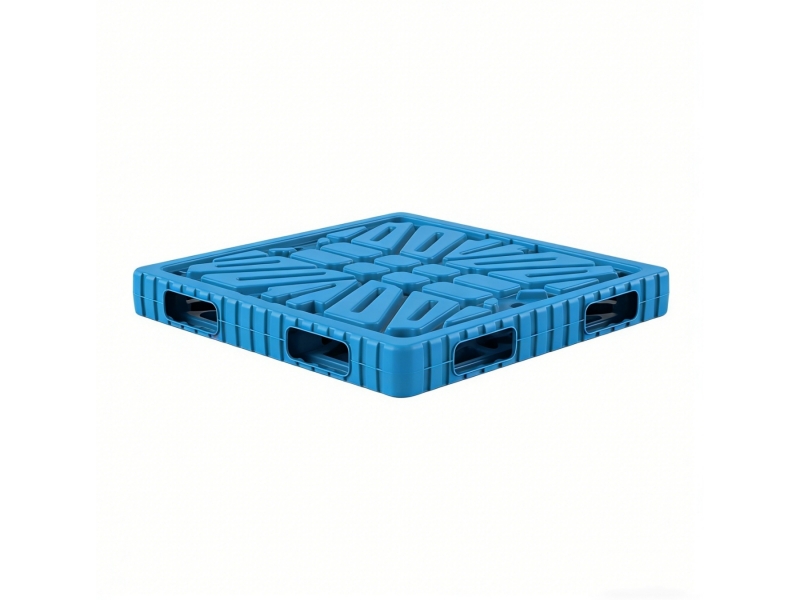
Double-Face Pallets
The classic format: two flat deck surfaces connected by hollow structural columns. Both surfaces are usable, so you can flip the pallet when one side shows wear, which meaningfully extends service life.
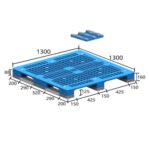
Double-face blow molded pallets are the go-to for heavy-load warehouse applications, racking systems, and production environments with repeated pallet use. Standard sizes include 1200×1000mm (European standard) and 1200×1200mm (common in Asia-Pacific markets). Custom dimensions are available for specialized applications.
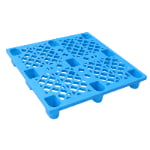
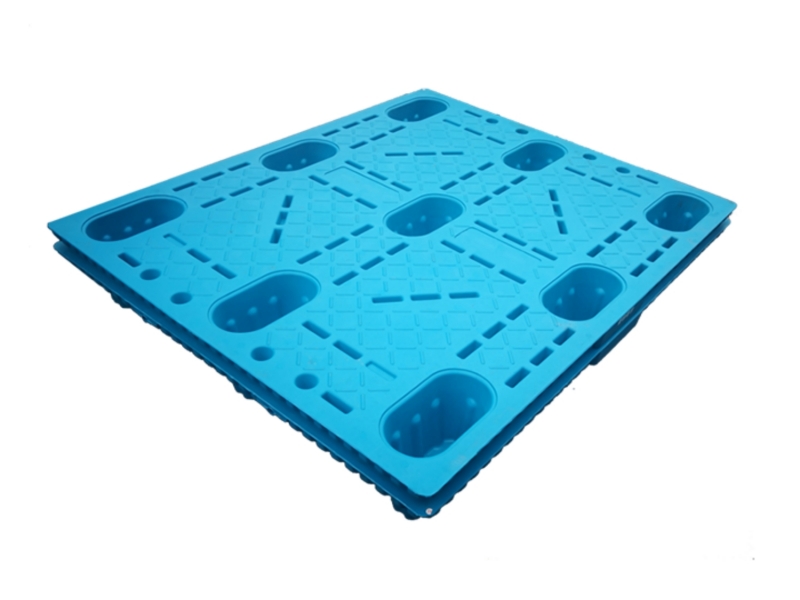
9-Leg Nestable Pallets
9-leg nestable blow molded pallets are the fastest-growing segment in blow molded plastic pallets — and it’s easy to see why. When empty, they stack inside one another, reducing return freight costs and storage space by up to 75% compared to double-faced designs.
These pallets are lighter (typically 8–14kg vs. 18–25kg for double-faced) and well-suited for one-way or limited-use logistics chains. They’re widely used in FMCG distribution, retail supply chains, and export applications.
Key Performance Specs of Blow Molded Pallets
These are the numbers that matter when you’re deciding whether a pallet fits your operation. Use them as a baseline, and always ask for test data specific to the product you’re evaluating.
Load Capacity
- Double-faced pallets: dynamic load 2–3 tonnes, static load 4–6 tonnes (on firm, flat floor)
- Nine-leg nestable pallets: dynamic load 1–1.5 tonnes, static load 2–4 tonnes
Dynamic load = weight during movement (forklift, conveyor). Static load = stationary weight bearing (stacked storage). Both matter — static load limits are often much higher, but only apply when the pallet isn’t moving.
Temperature Range
Standard HDPE pallets operate reliably from -40°C to 70°C. PP variants extend the upper range to approximately 100°C. If your operation involves blast freezing or high-temperature processing, confirm the spec with your supplier.
Service Life
Typically 5–10 years under normal use conditions — substantially longer than wood pallets, which are more prone to cracking under repeated impact. The one-piece hollow structure of a blow molded pallet is genuinely more resilient.
Impact Resistance
Blow molded pallets absorb and distribute impact energy better than wood. In practice: fewer splinters, no cracking under repeated forklift strikes, and fewer pallets pulled from service for damage. In a high-throughput facility, that difference adds up fast.
Where Are Blow Molded Pallets Used?
The performance profile of blow molded pallets — seamless structure, impact resistance, temperature stability — makes them a natural fit across several demanding industries.
Food & Beverage
Blow molded pallets have no crevices or hollow joints where bacteria can accumulate. The smooth, closed surface cleans easily with standard detergents and sanitizers. For operations that handle open food products or require regular pallet washing, this is a significant hygiene advantage over wood.
Pharmaceutical & Cold Chain
Cold chain operations need pallets that stay structurally sound at low temperatures. Blow molded HDPE pallets hold their shape and impact resistance down to -40°C — a range where wood splinters and loses structural integrity.
Export & International Shipping
This is one of the most compelling use cases for plastic pallets. Wood pallets used in international trade must comply with ISPM 15 — the phytosanitary standard requiring heat treatment or methyl bromide fumigation to prevent cross-border pest transfer.
Plastic pallets are fully exempt from ISPM 15. No fumigation, no treatment certificates, no customs delays caused by non-compliant wood. For exporters shipping to multiple markets, this simplifies compliance and removes a recurring operational cost.
Heavy Industry & Warehousing
In environments where forklifts are moving constantly, pallet durability directly affects operating costs. Blow molded pallets don’t absorb moisture, warp, or splinter — all common failure modes for wood pallets in industrial settings. The impact-resistant structure handles the physical demands of high-frequency forklift use better than most alternatives.
Choose Your Blow Molded Pallets with Confidence
You now know what separates a well-made blow molded pallet from a borderline one: material grade, process control, cooling consistency, and load testing that actually happens before the pallet leaves the factory. That’s not industry jargon — it’s the difference between a pallet that lasts five years and one that fails in the first quarter.
Not sure whether a double-faced or nestable design fits your operation? Unsure which load rating you actually need? Sourcing pallets across multiple markets and worried about compliance? These are exactly the questions we handle every day.
CN Plast manufactures blow molded and injection molded plastic pallets across a full range of specifications and custom dimensions. Tell us your load requirements, operating environment, and volume, and we’ll recommend the right product with full spec documentation and test data to back it up.