You’ve probably seen them on factory floors, in chemical warehouses, in the back of freight trucks. But how much do you actually know about how IBCs work? What makes one fail? And what happens when 1,000 liters of industrial liquid hits an unprotected floor?
If you’re sourcing IBCs — or responsible for storing them safely — the answers matter more than you might think. This guide covers everything from IBC types and standard sizes to spill containment compliance, so you can make the right call before something goes wrong.
What’s an IBC?
IBC stands for Intermediate Bulk Container. In plain terms, it’s a large, reusable industrial container built to store and transport high volumes of liquid, paste, or granular material — typically between 275 and 330 gallons (roughly 1,000–1,250 liters) in a single unit. If you’ve ever spotted a square plastic-and-metal tank sitting on a pallet in a warehouse or chemical plant, that’s an IBC.
The word “intermediate” is the key to understanding what makes it different. It sits between two extremes: on one end, you have small containers like bottles and 55-gallon drums; on the other, you have fixed storage tanks that stay in one place. An IBC is the middle ground — big enough to move meaningful quantities of product, but still portable enough to load onto a truck, fork lift into a racking system, or ship overseas.
Think of it this way: where you’d need 18 standard 55-gallon drums to move 1,000 liters of chemical, one IBC does the same job — with one handling step, one valve, and far less labor. That’s the core appeal, and it’s why IBCs have become a default packaging format across chemical, food, pharma, and agriculture supply chains worldwide.
What Is an IBC Used For?
IBCs are built for bulk handling — not small quantities. A single IBC typically holds between 275 and 330 gallons (roughly 1,000–1,250 liters), which immediately makes it far more efficient than managing four or five separate 55-gallon drums for the same volume.
You’ll find them in use across a wide range of industries:
- Chemical & petrochemical — acids, solvents, lubricants, and industrial cleaning fluids
- Food & beverage — edible oils, syrups, liquid flavorings, and bulk dairy ingredients
- Pharmaceutical — bulk active ingredients and process fluids
- Agriculture — fertilizers, pesticides, and liquid animal feed
- Construction & coatings — resins, paints, adhesives, and water treatment chemicals
The core appeal is straightforward: one IBC does the work of multiple drums, with fewer handling steps, less packaging waste, and a smaller storage footprint. For procurement teams managing high-volume liquid flows, that efficiency adds up quickly.
What Are the Main Types of IBCs?
Not all IBCs are built the same — your choice depends on what you’re storing and how you need to move it. Here are the three main categories.
Rigid IBC
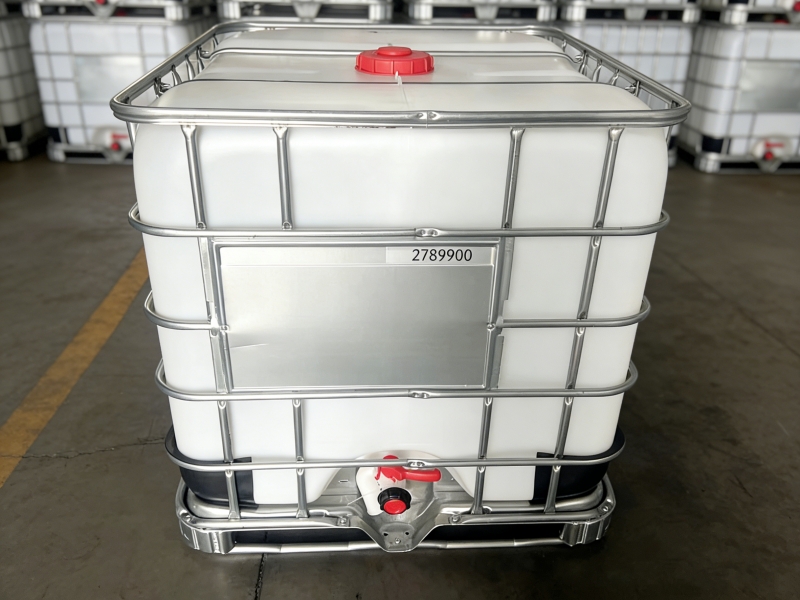
This is the type most people picture when they hear ‘IBC.’ A rigid IBC consists of an HDPE or LLDPE inner bottle enclosed in a galvanized steel cage, all mounted on an integrated pallet base. It handles liquids well, tolerates rough handling, and is designed for repeated use — typically stackable, forkliftable, and easy to clean between cycles. It’s the dominant format in chemical, food, and industrial applications.
Flexible IBC (FIBC / Big Bag)
Also known as a bulk bag or super sack, a flexible IBC is made from woven polypropylene. Think of it as an oversized industrial tote bag — lightweight, collapsible when empty, and designed primarily for dry bulk materials like powders, granules, grains, or pellets. It’s cost-effective for single-use or limited-reuse scenarios and widely used in agriculture, chemicals, and construction.

What Happens When an IBC Leaks?
A single IBC holds up to 1,000–1,250 liters of liquid. That’s a lot of volume to lose control of. IBC leaks are more common than most people expect — a faulty bottom valve, a cracked fitting, a damaged inner bottle, or simply an improperly sealed cap can all trigger a spill. And when one does happen, the consequences scale quickly.
For your team, a chemical spill on an unprotected floor creates immediate slip and exposure hazards. For your facility, liquid that reaches floor drains can enter municipal wastewater systems — triggering regulatory violations even if the substance isn’t acutely toxic. For the environment, certain industrial fluids (lubricants, solvents, pesticides) are classified as water-hazardous, meaning even a partial spill reaching soil or groundwater can result in costly remediation and significant fines.
Consider a real-world scenario: a food processing plant stores edible oil in several 1,000L IBCs. An overnight valve failure goes undetected until the morning shift. By then, several hundred liters had spread across the warehouse floor, reached a drain connected to the stormwater system, and contaminated a nearby waterway. The cleanup cost and the regulatory penalty both dwarf whatever was saved by skipping secondary containment.
This is precisely why secondary containment isn’t optional in most jurisdictions — and why the IBC spill containment pallet exists.
What Is an IBC Spill Containment Pallet?
Here’s where the safety picture comes in. An IBC holds up to 1,000+ liters of liquid. If a bottom valve fails or a fitting cracks, that’s a large-scale spill — with real consequences for your facility, your team, and the environment.
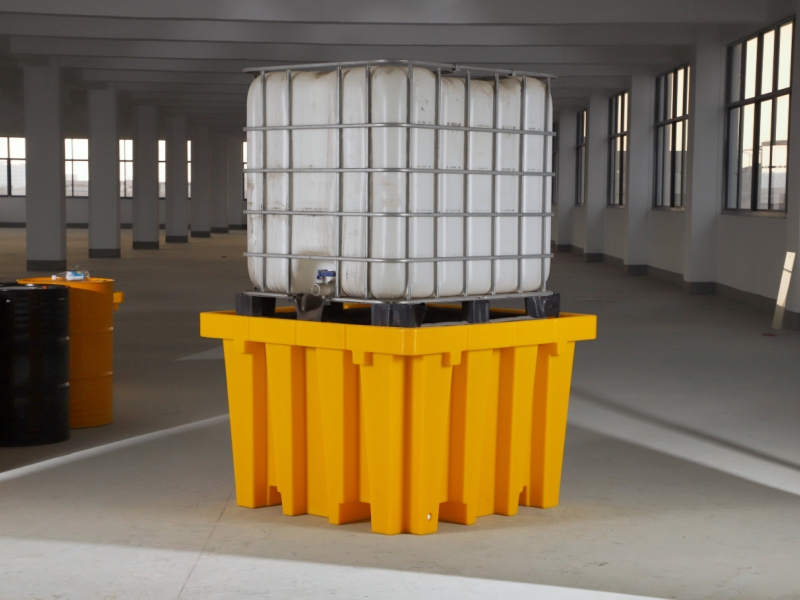
An IBC spill containment pallet (sometimes called a spill pallet, IBC containment pallet, or pallet spill containment unit) is a secondary containment platform placed directly beneath an IBC. Its job is simple: catch any leaks or overflows before they reach the floor, drain into the drainage system, or contaminate groundwater.
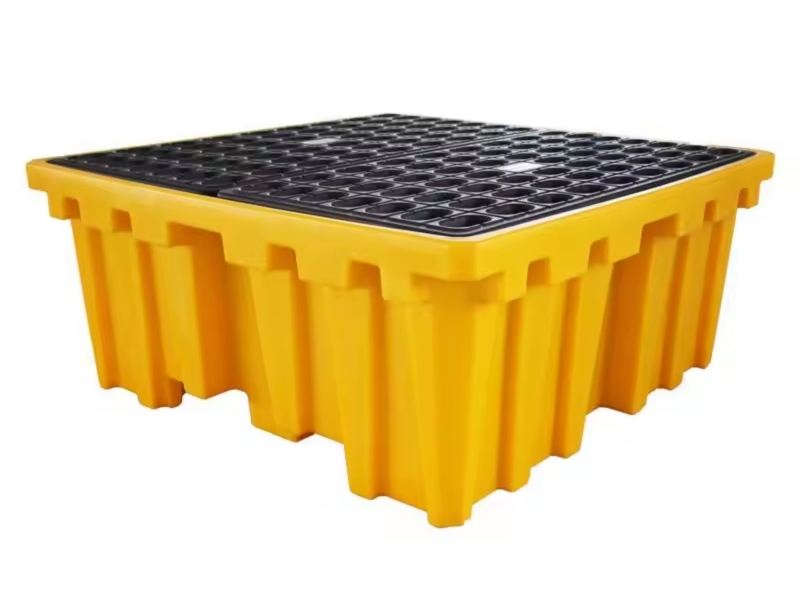
The structure consists of two key parts. First, a grated load deck on top — sturdy enough to support the full weight of a filled IBC — which allows any leaked liquid to drain downward. Second, an enclosed sump beneath the deck that collects and holds the fluid until it can be safely removed.
The sump volume is a critical spec, not a secondary one. Most regulatory frameworks require the sump to hold at least 110% of the IBC’s maximum storage volume. For a standard 1,000L IBC, that means your spill containment pallet needs a minimum sump capacity of 1,100L.
IBC spill containment pallets are made from LLDPE (Linear Low-Density Polyethylene) and formed using rotational molding(rotomolding) — a process that produces seamless, one-piece construction with no joints or weld lines where leaks could form. The result is a pallet that’s both chemically resistant and tough enough to handle the full weight of a loaded IBC day after day.
If you want to learn more about rotomolding, our guide “What Is Rotomolding?” breaks it down in full detail.
What Types of IBC Spill Containment Pallets Are There?
The right spill containment solution depends on how many IBCs you’re storing and how much floor space you have. Here’s a breakdown of the main formats you’ll encounter.
Single IBC Spill Containment Pallet
Designed to hold one IBC. A typical model measures around 1,380mm × 1,380mm × 900mm with a sump capacity of 1,600L — fully compliant for a standard 1,000L IBC. This is the most common choice for facilities that store IBCs individually, in separate bays, or where chemical segregation is required. The 2-way entry options let you fit them into most warehouse configurations.

Double IBC Spill Containment Pallet
Handles two IBCs side by side on a single extended platform. These are typically around 2,200mm × 1,300mm in footprint and offer a combined sump of 1,100L or more. A good choice when you’re running paired storage and want to reduce the number of separate containment units on your floor. Some facilities use these to store two IBCs of compatible materials together while maintaining a single containment perimeter.
4-Drum Spill Containment Pallet
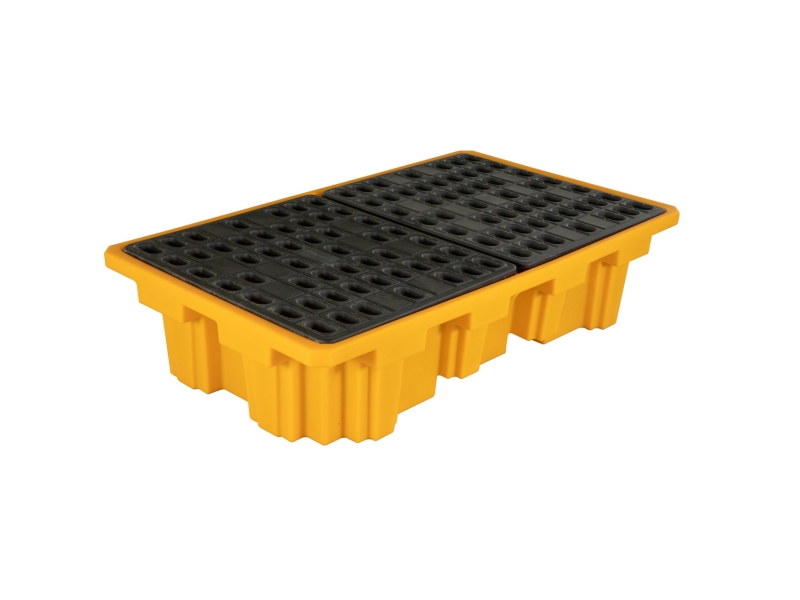
While designed for standard 55-gallon drums, the 4 drum spill containment pallet often appears in IBC-adjacent workflows where drums and IBCs coexist in the same storage area. A typical 4-drum model is high-profile — around 1,600mm × 1,600mm × 700mm. If your operation mixes drum and IBC storage, these two formats can be paired on the same floor plan.
How Do You Choose the Right IBC Spill Pallet?
There’s no single right answer — but a few key factors will narrow it down fast. Get these right and the rest of the decision is straightforward.
Sump Capacity vs. IBC Volume
This is non-negotiable. Your IBC spill containment pallet sump must hold at least 110% of the largest container it supports. Most buyers go slightly over that threshold for peace of mind — a 1,100L sump for a standard 1,000L IBC is a common and practical choice.
Load Capacity (UDL Rating)
A filled 1,000L IBC weighs around 1,300–1,500kg. Your pallet’s UDL (uniform distributed load) rating must comfortably exceed that. Always check this spec in the datasheet — don’t assume a visually similar pallet has the same load ceiling.
Forklift Entry: 2-Way vs. 4-Way
2-way entry means forklifts can only enter from two opposing sides. 4-way entry adds side access — useful in tight aisles or when your site layout requires lateral approach. If you’re not sure, 4-way gives you more flexibility.
Material: HDPE / LLDPE vs. Steel
For most chemical and industrial liquids, HDPE or LLDPE is the go-to material — chemically resistant, UV-stable, lightweight, and easy to clean. For highly flammable or electrostatic-sensitive liquids, conductive or steel pallets may be required under local fire safety codes. Check your substance’s compatibility before specifying material.
Indoor vs. Outdoor Use
Indoor use is straightforward. Outdoor deployments introduce two additional considerations: UV stabilization (to prevent material degradation in sunlight) and drainage plug management. When it rains, your sump collects rainwater on top of any captured spill fluid — you need a strategy for controlled drainage that doesn’t risk releasing contaminated liquid.
What Regulations Apply to IBC Spill Containment?
This isn’t just a best practice — in most markets, secondary containment is a legal requirement. The specifics vary by region, but the core logic is consistent: if a vessel holding hazardous liquid fails, something must stop that liquid from reaching the environment.
United States: EPA SPCC & OSHA
The EPA’s Spill Prevention, Control, and Countermeasure (SPCC) rule under 40 CFR Part 112 is the primary framework. It requires secondary containment sized to hold 110% of the capacity of the largest container, or 10% of the total aggregate storage volume — whichever is greater. OSHA 29 CFR 1910 adds workplace-level requirements for hazardous liquid storage environments.
European Union: ADR & Local Environmental Law
In the EU, IBC transport and storage of dangerous goods falls under the ADR framework. Country-level environmental protection laws (such as Germany’s WHG water pollution control regulations) also mandate secondary containment for IBCs storing water-hazardous substances — even when stored temporarily indoors.
UN Certification & International Standards
For UN-certified IBCs carrying hazardous liquids in international trade, the spill containment pallet used should also meet relevant performance standards. Not every pallet qualifies. When sourcing for cross-border operations, look for pallets certified under ISO 9001 at minimum — and ideally against SPCC, OSHA, SGS, FDA, REACH, ROHS, CE, and UN standards depending on your destination markets.
At CN Plast, our IBC spill containment pallets are manufactured to meet this full certification stack, so your compliance documentation stays clean across the US, EU, and Australian markets.
Need an IBC Spill Containment Pallet That Meets Compliance Standards?
By now, you know what an IBC is, why leaks happen, and what it takes to contain them properly — sump capacity, material, load rating, forklift entry, and compliance. That’s not trivial knowledge. Most facilities only think about secondary containment after an incident. You’re thinking about it now, which already puts you ahead.
The right IBC spill containment pallet doesn’t just satisfy a regulatory checkbox. It protects your team, keeps your facility drainage clean, and removes a significant liability from your operations. Done right, it’s one of the lowest-cost, highest-impact decisions in your storage setup — and now you have everything you need to make it confidently.
At CN Plast, we are a dedicated plastic pallets manufacturer with over 26 years of experience supplying LLDPE rotomolded IBC spill containment pallets to chemical, food, pharmaceutical, and industrial clients worldwide. Our single IBC spill pallet, double IBC spill pallet, and drum spill containment pallet lines are certified to ISO 9001, SGS, ROHS, FDA, CE, REACH, UN, CTT EN-840, and GRS standards — with full certification documentation ready for your compliance files.
Not sure which model fits your sump requirement or site layout? Tell us your IBC volume, the liquid you’re storing, and your forklift access configuration. We’ll specify the right custom IBC spill containment pallet for you.