Most people don’t think twice about pallets. The reality is that pallet types vary far more than most buyers expect. Material, structure, size, entry type, deck surface, manufacturing process — each variable affects how your goods move, how your facility operates, and how much the whole thing costs over time.
This guide breaks down every major pallet type in plain terms: from wood vs. plastic vs. metal, to 2-way vs. 4-way entry, to specialty formats built for specific industries. Whether you’re sourcing pallets for the first time or rethinking a system that isn’t working, you’ll find a clear, practical framework here to make the right call.
What Is a Pallet and What Is It Used For?
A pallet is a flat, rigid platform used to stack, store, and move goods — typically with a forklift, pallet truck, or conveyor system. Almost every product you buy has spent time on one. They’re the foundation of modern warehousing and freight logistics, and they matter more than most people realize.
Getting the right pallet matters because the whole system around it — trucks, racking, dock doors, conveyor widths — is built to specific dimensions and load requirements. Industrial pallets are standardized precisely so that goods can move seamlessly from the factory floor to the warehouse to the retail shelf without being repacked at every step. If your pallets don’t match your infrastructure, everything costs more.
What Are the Different Types of Pallets by Size?
Pallet sizes aren’t universal — they vary by region, industry, and infrastructure. Choosing the wrong size means wasted truck space, incompatible racking, and friction at every handoff point.
European Pallet Size (Euro Pallet / EPAL)
The Euro pallet measures 1200×800mm and is the dominant format across Europe. It’s ISO-certified and sized to fit two across the width of a standard European truck, leaving virtually no wasted space. If you’re shipping within Europe or working with European suppliers, this is almost certainly the format your partners expect.
US Standard Pallet Size
In North America, the standard is 48″×40″ (approximately 1200×1000mm), commonly called the GMA pallet. It aligns with US retail and distribution infrastructure — grocery chains, big-box retailers, and most major 3PLs are built around this size. If you’re operating in the North American market, this is your default.
Other Common Pallet Sizes
Outside of the two main standards, pallet sizes vary by region and industry:
| Industry / Application | Common Sizes (mm) |
| Food, pharma, cosmetics & cold chain | 1200×1000, 1200×800 |
| Industrial & bulk goods (chemical, fertilizer, cement, grain, edible oil, flour & rice) | 1200×1000, 1200×1200, 1300×1100, 1400×1100, 1400×1200, 1500×1200, 1500×1300, 1500×1500 |
| Automotive | 1200×1000, 1200×800 |
| Beverage & bottled water | 1200×1000 |
| Textile | 1200×1000, 1500×1500 |
| Automated warehouses & racking systems | 1200×1000, 1200×800, 1300×1100, 1400×1200 (custom on request) |
If you’re shipping across multiple regions, confirm which sizes your warehouses and carriers can handle before you commit to a format — changing pallet sizes mid-operation is a costly fix.
What Are the Different Types of Pallets by Material?
The material of a pallet shapes its weight capacity, lifespan, hygiene level, and total cost. Here’s what each option actually means in practice.
Wood Pallets
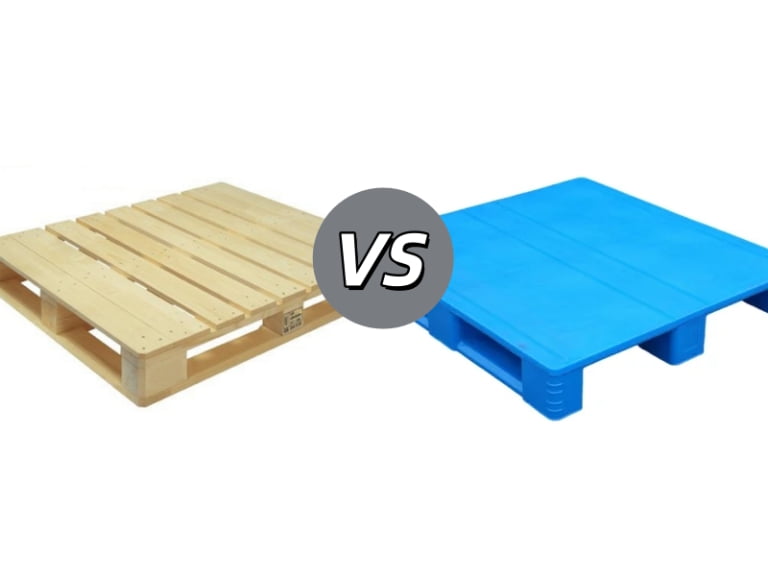
Wood is still the most widely used pallet material globally — it’s affordable, easy to repair, and available almost everywhere. Hardwood pallets handle heavier loads; softwood pallets are lighter and cheaper.
One thing to watch: if you’re exporting, wooden pallets must comply with ISPM 15, an international phytosanitary standard that requires heat treatment or fumigation to prevent pest transfer. Most reputable suppliers will stamp compliant pallets with the ISPM 15 mark — always check before shipping internationally.
Wood pallets work well for general warehousing and domestic freight. That said, stricter hygiene standards and the rise of automated warehousing are pushing many operations to switch to plastic — and that shift is only accelerating.
Plastic Pallets
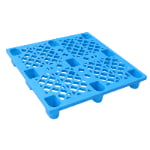
Plastic pallets — typically made from HDPE or PP — are increasingly the go-to for industries where hygiene and consistency matter. They don’t absorb moisture, don’t harbor bacteria, and are exempt from ISPM 15 requirements, which simplifies international shipping significantly.
They’re also dimensionally stable, meaning your automated systems (conveyor lines, AS/RS) won’t be fighting warped boards or uneven decks.
Two trade-offs worth knowing: upfront cost is higher than wood, and when plastic pallets do fail, they typically can’t be field-repaired the way wood can. For high-frequency closed-loop operations, though, the long-term cost per trip often comes out lower.
Common applications: food & beverage, pharmaceutical, cold chain logistics, export.
Metal Pallets
Metal pallets — steel or aluminum — are built for conditions where wood and plastic simply won’t hold up. Steel handles the heaviest loads and extreme temperatures; aluminum offers similar durability at roughly half the weight, which matters when you’re paying for airfreight.
These are heavy-duty pallets used primarily in automotive manufacturing, aerospace, and military logistics. They’re not a general-purpose solution — the cost and weight make them overkill for standard warehousing — but in the right environment, nothing else comes close.
Paper Pallets
Paper pallets (also called slip sheets or eco pallets) are flat, lightweight, and fully recyclable. They’re designed for light loads shipped by air, where every kilogram costs money. No forklift needed — they’re typically moved with push-pull attachments.
The limitations are real: they’re single-use in most cases, sensitive to moisture, and can’t handle heavy or sharp-edged cargo. But for the right use case — light, dry, air-freighted goods — they cut costs meaningfully.
For more information on pallet materials, check out our article: The materials of the pallets: 5 materials for enhancing operational efficiency.
What Are the Different Types of Pallets by Structures?
Structure determines how a pallet is loaded, moved, and stored — not just how it looks. These structures apply specifically to plastic pallets, and each of the four main designs solves a slightly different problem.
3-Runner Pallet
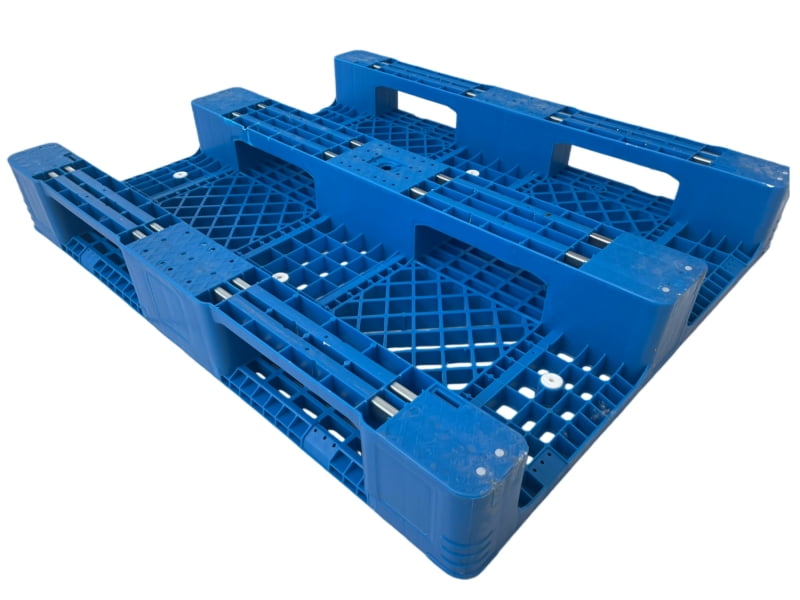
Three parallel boards (runners) run the full length of the pallet, leaving the underside open on two sides. This makes it compatible with both forklifts and manual pallet trucks — useful in mixed operations where not every warehouse has a forklift on every floor. It also handles edge racking well, since the runners provide solid, continuous support along the length.
6-Runner Pallet
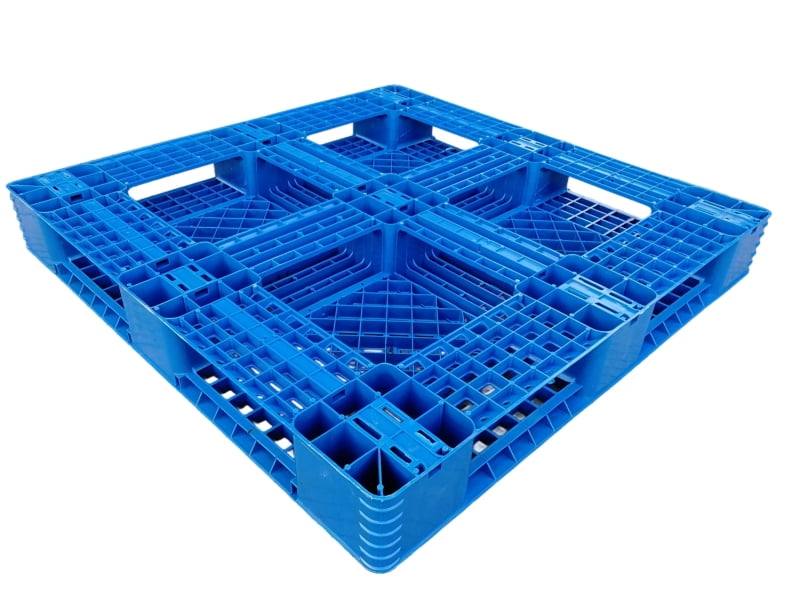
Add a full perimeter frame and a cross-runner, and you get a 6-runner design. The additional contact area distributes load more evenly, which matters when you’re stacking heavy loads or dealing with uneven floors. It’s a stronger, more stable structure — at the cost of slightly more material and weight.
9-Leg Pallet
Nine individual legs instead of continuous runners. The key advantage: 9-leg pallets are nestable, meaning empty pallets stack into each other rather than sitting flat on top. That can cut return-trip storage space by 60–70%, depending on the design. Common in beverage and retail distribution, where empty pallet management is a real operational cost.

Reversible Pallet
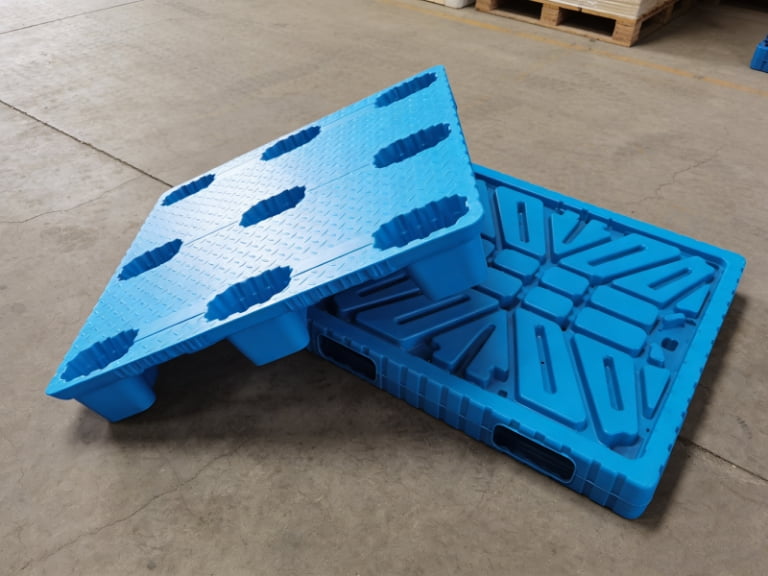
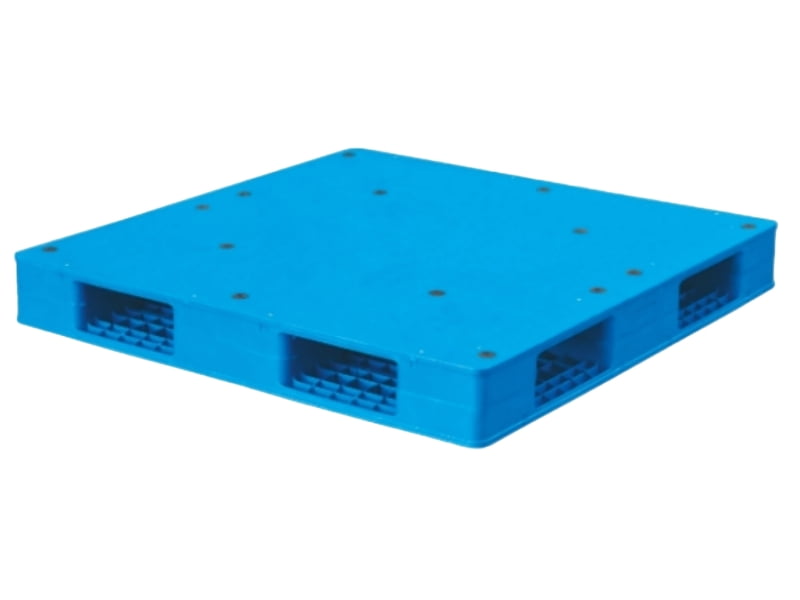
Both top and bottom decks are identical, so the pallet can be flipped and used on either side. This doubles the usable surface and extends service life. Reversible pallets are compatible with both forklifts and pallet jacks — just confirm the entry clearance matches your equipment before ordering.
2-Way vs 4-Way Entry: What’s the Difference?
Entry direction might sound like a minor detail, but in a busy warehouse, it affects how fast your team can move and how flexible your racking layout can be.
2-way entry pallets only allow forklift access from two sides (front and back). They’re simpler and often cheaper to produce, and they work fine in straightforward in/out operations with predictable traffic flow.
4-way entry pallets — also called four-way pallets — can be entered from all four sides. This matters when your forklifts need to approach from different angles, or when your racking system doesn’t always allow a straight-on approach.
In most modern warehouse environments, 4-way entry is the default recommendation. The operational flexibility it provides outweighs the marginal cost difference, especially in high-throughput facilities where forklift time adds up.
Injection Molding vs Blow Molding: How Plastic Pallets Are Made
Both methods produce plastic pallets — but the manufacturing process creates real differences in strength, surface quality, and what environments they’re suited for.
Injection Molding
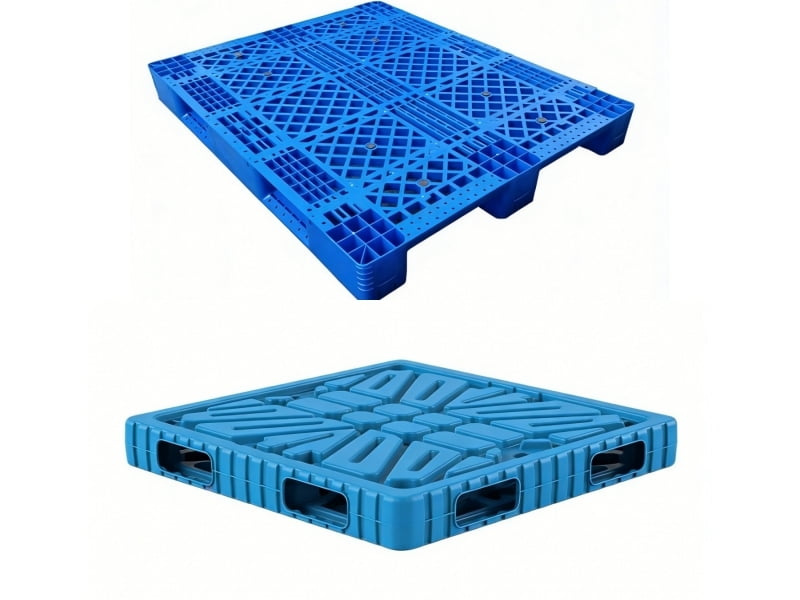
Molten plastic is injected into a closed mold under high pressure. The result is a dimensionally precise, smooth-surfaced pallet with consistent wall thickness. That consistency matters in automated systems where pallet dimensions have to be exact.
Injection-molded pallets are the standard choice for pharmaceutical, food processing, and clean-room environments. High tooling cost means the per-unit price drops significantly at volume — this is a high-volume production format.
Blow Molding
A plastic tube is inflated inside a mold, creating a hollow structure. The hollow construction actually increases impact resistance and makes these pallets handle temperature extremes well — typically rated from -40°C to +70°C.
Blow-molded pallets tend to be more durable in rough handling conditions and have a longer service life than injection-molded equivalents. The tradeoff is higher per-unit cost at lower volumes, and slightly less dimensional precision.
Vented Deck vs Solid Deck: Which One Do You Need?
Deck surface is often overlooked — but it directly affects hygiene compliance, load stability, and cleaning time.
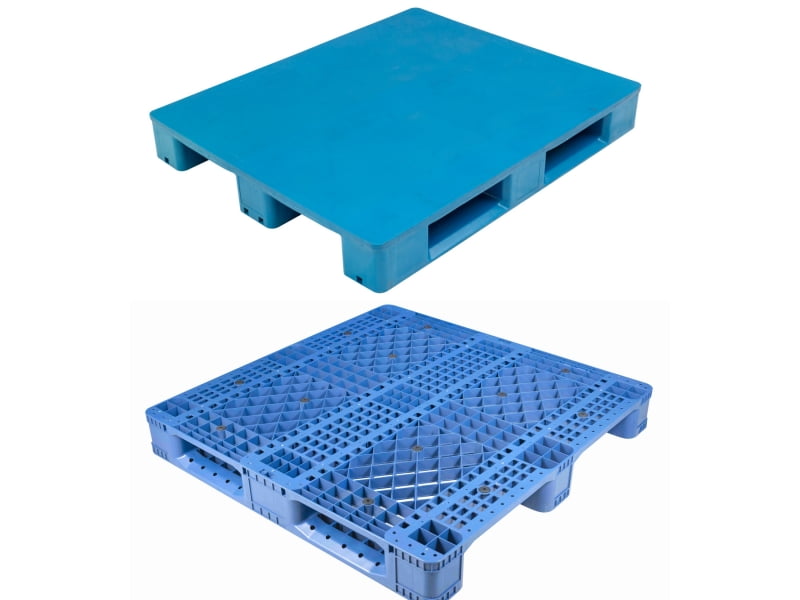
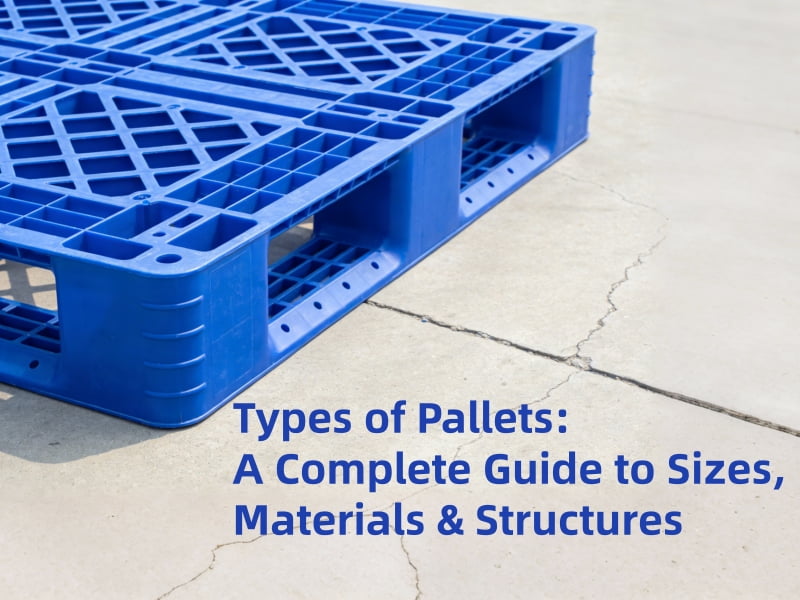
Vented deck pallets have an open grid surface. Air circulates freely, water drains through, and temperature distribution is more even. This makes them the standard in fresh produce, cold storage, and any application where airflow around the product matters.
Solid deck pallets have a fully closed surface. There’s nowhere for liquid, debris, or small products to fall through, which simplifies cleaning and reduces product loss. They’re the preferred format for food manufacturing, pharmaceutical, and retail environments handling small or loose items.
The short version: if airflow matters, go vented. If cleanliness and containment matter, go solid.
Specialty Pallets for Specific Use Cases
Most operations run on standard pallets — but some industries need designs built around a specific problem. These two specialty formats come up often enough to know.
Spill Containment Pallets
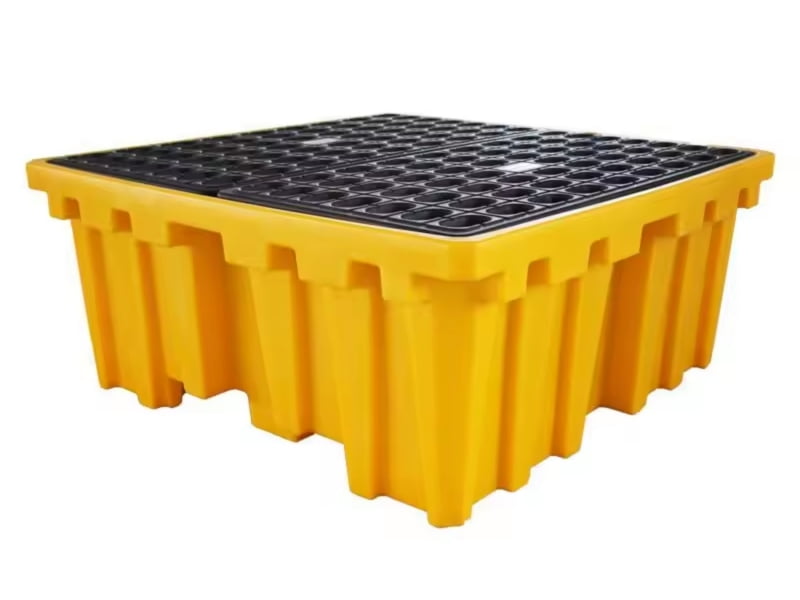
Spill pallets are designed with a built-in containment sump beneath the deck. If a drum, IBC, or container leaks, the liquid is captured rather than spreading across your floor. In many regions, storing hazardous materials without spill containment isn’t optional — SPCC regulations and EPA guidelines mandate it for qualifying facilities.
If you’re storing chemicals, lubricants, or any liquid classified as hazardous, a standard pallet isn’t compliant. A spill containment pallet is.
Water Bottle Pallets
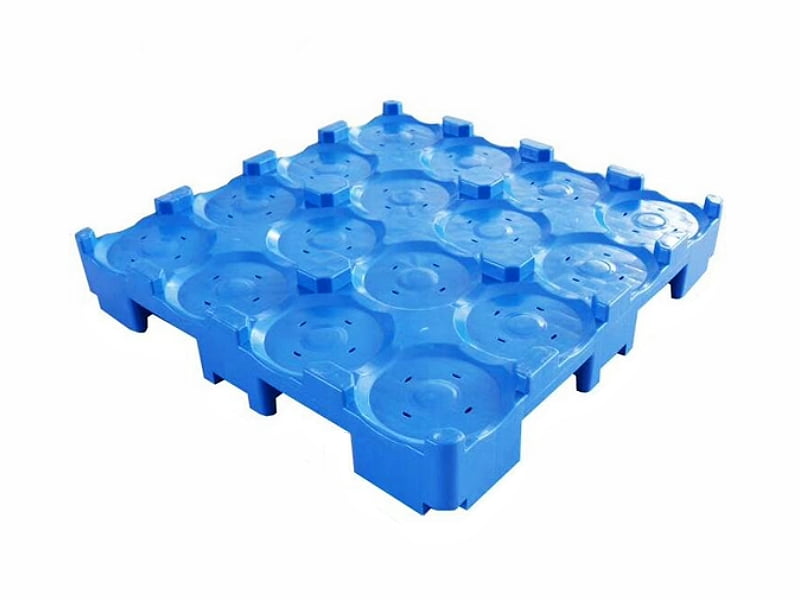
These pallets are purpose-built for 3-gallon and 5-gallon water bottles. The deck surface includes molded slots or raised rings that lock each bottle in position, preventing rolling during transport and reducing breakage. Standard flat pallets let bottles shift — water bottle pallets don’t.
They’re used throughout the bottled water supply chain: loading at the plant, transport to distribution centers, and retail floor display.
Printing Pallets
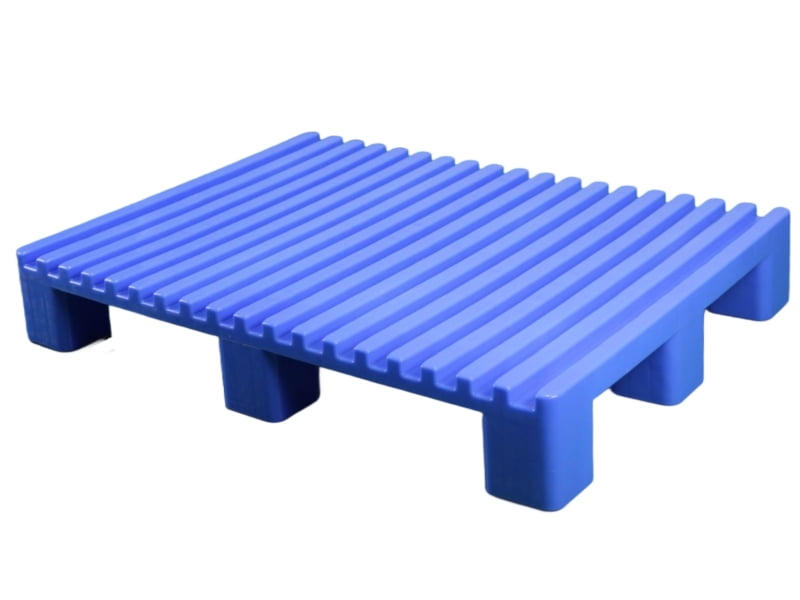
Printing pallets are designed to keep paper stacks perfectly aligned and consistently fed into printing machinery. By enabling continuous paper supply without stopping the press to reload, they eliminate the downtime that comes with manual paper changes — keeping production lines running and output rates high. If your operation runs high-volume print jobs, the efficiency gain adds up fast.
How to Choose the Right Pallet for Your Needs
There’s no single “best” pallet — the right choice depends on what you’re moving, where you’re moving it, and how often. Here’s how to think through it:
What’s the load? Heavy, dense cargo needs wood or metal. Light, air-freighted goods can use paper or thin-wall plastic.
What are your hygiene requirements? Food, pharma, and medical need plastic (solid deck, HDPE/PP). Standard industrial use? Wood is fine.
Are you exporting? Wood requires ISPM 15 certification. Plastic and paper skip that step entirely.
Is it a closed loop or one-way trip? Closed-loop operations (you get the pallet back) justify the higher upfront cost of plastic or metal. One-way shipments usually favor lower-cost wood or paper.
What does your facility use? If your warehouse runs manual pallet trucks, you need 2- or 4-way entry pallets with the right runner design. Automated systems need dimensionally consistent plastic pallets.
What’s the real cost? Wood pallets cost less upfront, but plastic pallets last longer and need less maintenance. Run the numbers over a full use cycle, not just the purchase price.
Not Sure Which Pallet Type Fits Your Operation? Let’s Figure It Out Together
Pallets are rarely the first thing on a buyer’s mind — but as you’ve seen, the wrong choice ripples through your entire supply chain: incompatible racking, failed compliance checks, higher per-trip costs, and operational bottlenecks that compound over time. Now that you understand the full landscape — from materials and structures to entry types and specialty formats — you’re in a far better position to make a decision that actually fits your operation, not just your budget line.
That clarity is worth something. Most sourcing mistakes happen before the first order is placed.
At CN Plast, we specialize in plastic pallets manufacturing — covering the full range of types discussed in this guide, from injection-molded food-grade pallets to heavy-duty 4-way entry designs for automated warehouses. Whether you’re navigating ISPM 15 requirements, spec’ing pallets for a cold chain facility, or simply trying to find a size that fits your existing racking, we’ve worked through these problems before.
Tell us your load, your industry, and your constraints — we’ll recommend the right type, size, and spec, and back it with a quote. No guesswork, no back-and-forth delays.
Get in touch with CN Plast today and let’s find the right pallet for your operation.